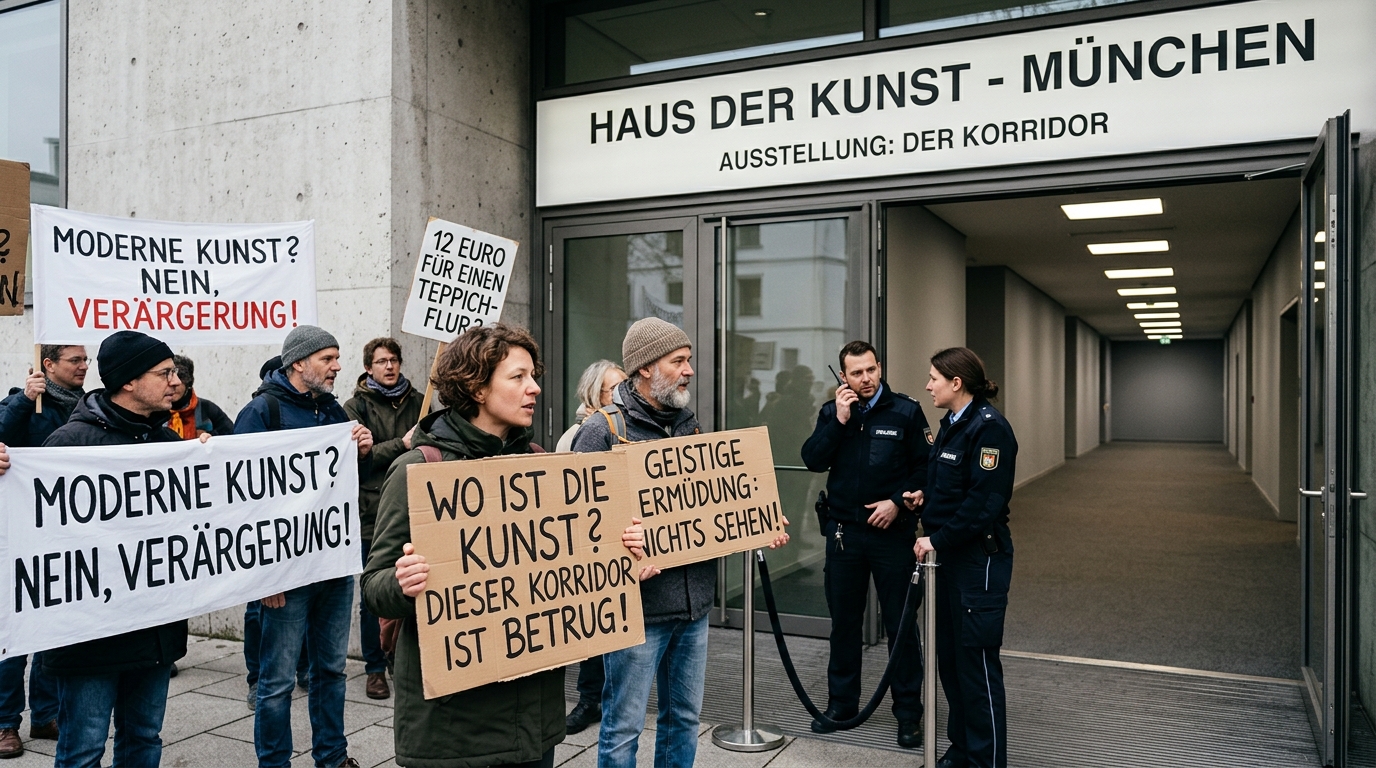
MUNICH—The Pinakothek der Moderne is facing formal administrative complaints and daily picketing following the opening of its highly anticipated autumn exhibition, "The Baseline," which consists entirely of a 14-meter-long corridor lined with standard industrial grey carpeting and illuminated by three slightly buzzing overhead fluorescent tubes.
The installation, designed by the minimalist art collective Gruppe Null, features no paintings, sculptures, or explanatory wall text. At the end of the hallway sits a single, locked utility door painted in a semi-gloss latex shade known commercially as "Agreeable Gray." A faint smell of floor wax and quiet air filtration completes the sensory profile of the space.
Since opening last Thursday, the exhibit has become the focus of intense local debate. The Bavarian Association of Gallery Goers has filed an official grievance with the state ministry of culture, accusing the museum of "aggressive neutrality" and demanding a partial refund of the €15 general admission ticket.
"Art is meant to challenge, provoke, or inspire," said association spokesperson Dieter Weber. "But this hallway merely replicates the precise emotional wavelength of waiting for a passport renewal. I spent twenty-four minutes in there trying to find a metaphor, and instead, I just remembered that I needed to purchase windshield wiper fluid. It is an act of cognitive theft."
The museum’s administration has vigorously defended the installation, describing it as a triumph of "hyper-subtraction."
"The public has become addicted to sensory escalation and curation-as-entertainment," said Dr. Helena Brandstätter, the museum's chief curator of contemporary installations. "By presenting an environment completely devoid of narrative, tension, or aesthetic hierarchy, 'The Baseline' forces the viewer to confront the terrifying luxury of absolute nothingness. If visitors feel bored, it is because they are confronting the void of their own internal lives."
The controversy has escalated to include regional consumer watchdogs. The Verbraucherzentrale Bayern has launched an inquiry into whether charging a premium admission fee for what is functionally an unimproved service corridor violates German consumer protection laws.
Museum officials argue that maintaining the space is highly resource-intensive. According to internal documents, keeping the corridor at a precise, unnoticeable state requires a specialized climate control program to neutralize all organic odors, ensuring the carpet smells neither of synthetic fibers nor of cleaning agents, but rather of "nothing at all."
Despite the pushback, some art theorists have praised the work. "The genius of the corridor is its absolute resistance to interpretation," said Dr. Stefan Koenig of the Munich Institute of Aesthetic Philosophy. "It is so thoroughly, meticulously unremarkable that it transcends art and becomes a form of spiritual administrative punishment."
At press time, the museum had declined to install a warning sign outside the gallery entrance, though staff have begun gently nudging visitors who have stood motionless in front of the locked utility door for more than forty minutes.