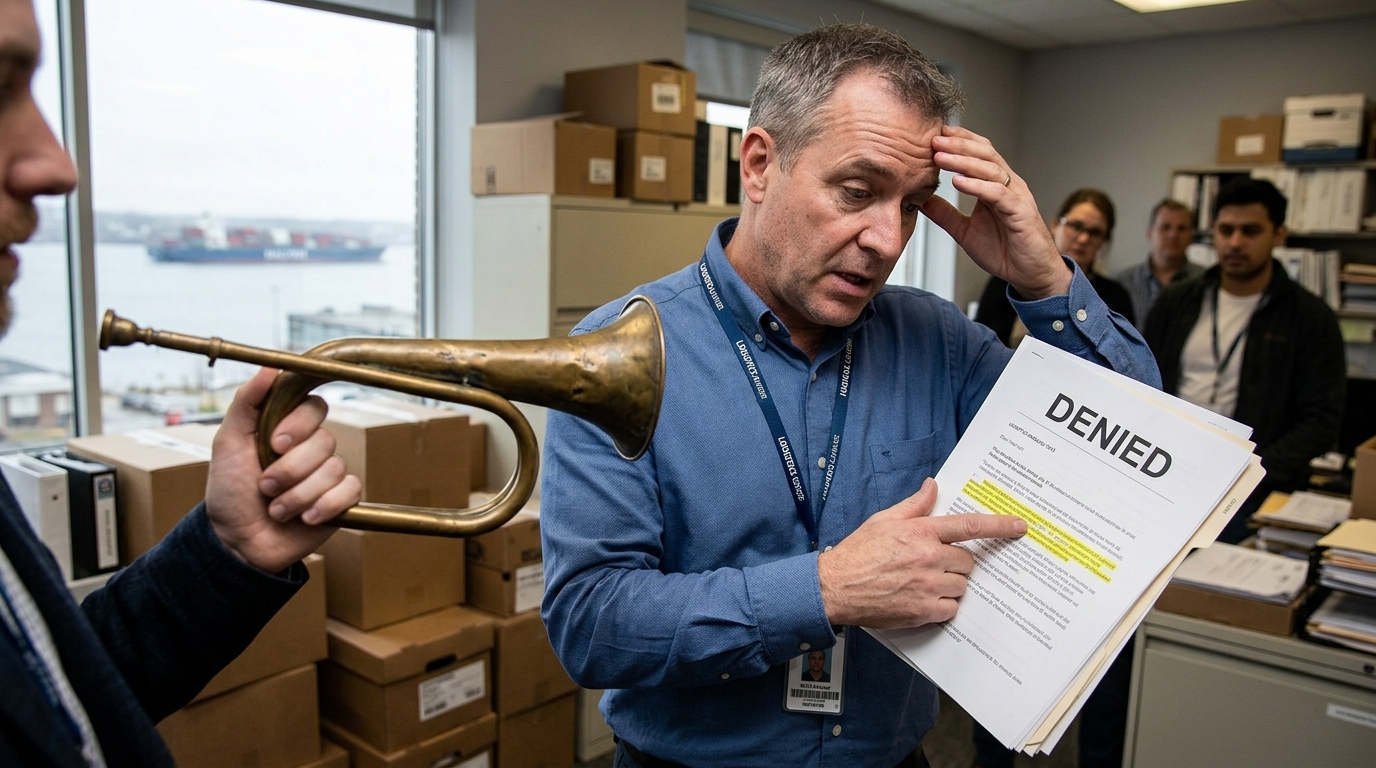
HALIFAX, Nova Scotia — A modern logistics firm seeking damages after a devastating autumn storm has had its $14.2 million insurance claim denied under an active 1847 policy clause requiring the physical deployment of a brass signaling horn during periods of high water.
The decision by Sovereign & Provincial Assurance, one of the oldest underwriting syndicates in the Commonwealth, has left executives at Apex Logistics scrambling to understand how a state-of-the-art, fully automated fulfillment center was expected to comply with mid-19th-century maritime defensive protocols.
The dispute centers on Apex’s flagship facility in the Port of Halifax, a 120,000-square-foot distribution hub utilizing automated guided vehicles, thermal climate sensors, and predictive LIDAR security systems. When Post-Tropical Storm Evelyn breached the harbor seawall last October, over four feet of saltwater inundated the facility’s lower level, destroying thousands of high-end consumer electronics and disabling the facility's robotic sorting fleet.
Following a three-week assessment, Sovereign & Provincial issued a formal denial of the claim, citing Section 14, Paragraph 3 of the Grand Junction and Atlantic Province Marine Indemnity Charter of 1847. The charter, which was absorbed into Sovereign & Provincial’s modern underwriting portfolio through a series of corporate acquisitions in the 1970s and 1990s, has never been formally amended.
According to the denial letter, the policyholder is required to maintain "a sober watchman of good repute upon the parapet" during any "inundation, tempest, or rising of the tides." The watchman’s sole duty, as outlined in the Victorian-era text, is to "sound a brass horn of no fewer than twelve inches in length to warn neighboring merchantmen and vessels of the Queen’s Navy of the impending hazard."
Because Apex Logistics operates an entirely dark facility managed by a central server in Montreal, no such watchman was on duty, and no brass horn was sounded.
"We have forty-two thermal cameras, an automated pneumatic floodgate system, and an API link that directly alerts the Halifax regional municipality’s emergency services within four milliseconds of water detection," said Marcus Vance, Chief Operating Officer for Apex Logistics. "None of those systems are programmed to blow a brass trumpet, because it is 2026. The insurer is treating a hurricane in the digital age as if it were an unannounced arrival of the French merchant marine."
In a statement, Sovereign & Provincial defended the denial, arguing that the historical clauses within their legacy policies remain vital instruments of risk mitigation.
"Our policies are living legal contracts that carry forward the foundational risk-management obligations of our chartering founders," said Beatrice Sterling-Hall, Chief Risk Officer for Sovereign & Provincial. "While we acknowledge the technological sophistication of the Halifax facility, the transition from sail to steam, and subsequently to fiber-optic automated logistics, does not contractually absolve the policyholder of their duty to warn the harbor. The acoustic properties of a brass horn remain a reliable, EMP-resistant method of signaling distress."
Legal experts say the case highlights a growing trend of insurers utilizing archival municipal and maritime charters to offset the skyrocketing costs of modern climate-related payouts. Because many commercial insurance policies are built on top of historic "all-risk" frameworks dating back to the British Empire, old exclusions are rarely deleted; instead, they are simply layered over with modern riders.
Dr. Fiona Gallagher, a professor of maritime law at Dalhousie University, noted that Sovereign & Provincial is within its legal rights under Canadian provincial insurance statutes, which protect the integrity of historical contracts unless explicitly overridden by modern legislation.
"Many commercial properties along the eastern seaboard are technically insured under covenants written during the timber trade era," Gallagher said. "If a modern policyholder does not carefully negotiate a 'De-Victorianization Rider' during their annual renewal, they remain legally bound to maintain dry stores of tallow, keep a loaded flintlock to deter privateers, or, in this case, blow a twelve-inch horn. The law does not assume a clause is dead simply because it is inconvenient to execute."
Sovereign & Provincial's adjusters reportedly confirmed the lack of compliance by reviewing the facility's own digital security footage. The report noted that while the automated floodgates deployed successfully, the facility remained entirely silent to the human ear throughout the storm, failing to meet the "clear acoustic warning" threshold established during the reign of Queen Victoria.
In response to the ruling, Apex Logistics has filed an appeal with the Nova Scotia Utility and Review Board, though legal experts warn a resolution could take years. In the interim, the logistics company has taken steps to ensure its other coastal facilities remain compliant with their historical underwriting terms.
"We have recently purchased fourteen vintage brass horns on eBay and are currently training our facility-maintenance algorithms to recognize the physical dimensions of a 19th-century harbor watchman," Vance said. "Though we are currently struggling to find a legal definition of 'sober' that applies to a server rack."