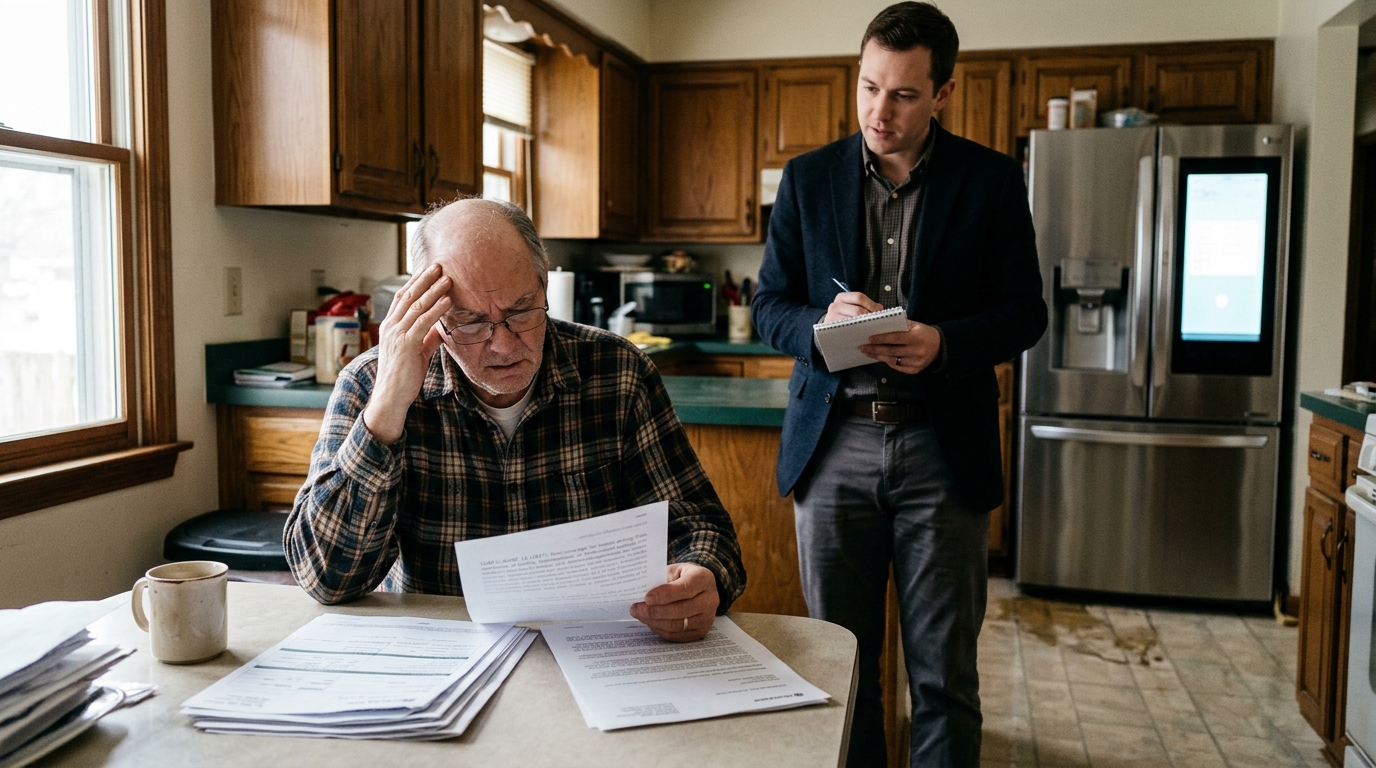
TOLEDO, Ohio — A local homeowner’s insurance claim for water damage caused by a malfunctioning smart-refrigerator has been denied under a 179-year-old policy exclusion originally written to protect underwriters from steamboat explosions on the Ohio River.
Mark Henderson, 42, filed a claim with Great Lakes Mutual in May after a severed plastic line on his Wi-Fi-enabled refrigerator flooded his kitchen, causing an estimated $14,200 in damage to his hardwood flooring. Last week, Henderson received a formal denial letter citing Article XIV, Section 4 of the insurer’s 1847 corporate charter.
The clause, written in Spencerian script and attached to Henderson’s digital denial receipt as a high-resolution JPEG, exempts the company from coverage in the event of "the bursting, cleaving, or catastrophic venting of any steam-packet, locomotive boiler, or other pressurized coal-fired maritime apparatus."
"I thought it was a formatting error or a cyberattack," Henderson said. "The denial letter was accompanied by a digitized copy of a document signed by a registrar who, according to a quick search, died of cholera during the Polk administration. They are claiming my refrigerator is a steamboat."
According to Great Lakes Mutual, the denial is a straightforward application of contractual definitions. In a letter to the Ohio Department of Insurance, company adjusters argued that because the refrigerator utilizes a compressor to pressurize vaporized tetrafluoroethane coolant, it qualifies as a "pressurized vessel utilizing vapor to alter ambient thermodynamic states."
"While we understand Mr. Henderson’s frustration, we must adhere strictly to the terms of our foundational charter," said Arthur Vance, senior vice president of claims at Great Lakes Mutual. "A pressurized thermal loop is a pressurized thermal loop, whether it is propelling a 30-ton paddlewheeler up the Mississippi or keeping three pounds of organic strawberries at a crisp 38 degrees. The physics of vapor expansion do not change simply because we have entered the digital age."
State regulators confirmed Tuesday that the 1847 charter remains legally binding. When Ohio modernized its insurance code during the constitutional convention of 1851, hundreds of pre-existing corporate charters were grandfathered in perpetuity to protect the state’s infant mercantile sector from insolvency.
Legal experts say such archaic exemptions are increasingly being excavated by insurers looking to offset rising payout costs associated with climate change and smart-home technology.
"Historically, companies ignored these clauses because the public relations cost was too high," said Dr. Evelyn Thorne, a professor of contract law at Case Western Reserve University. "But in the current market, we are seeing a quiet revival of antebellum liability law. If you look closely at your policy, you may find you aren't covered for roof damage if your shingles were compromised by 'the stray discharge of a Union Army mortar battery.'"
Henderson is currently appealing the decision, though his prospects remain dim. Great Lakes Mutual has already notified him that his premium will increase next quarter due to his home's proximity to a municipal drainage ditch, which the company’s 1847 charter classifies as a "malarial marsh of high pestilential risk."