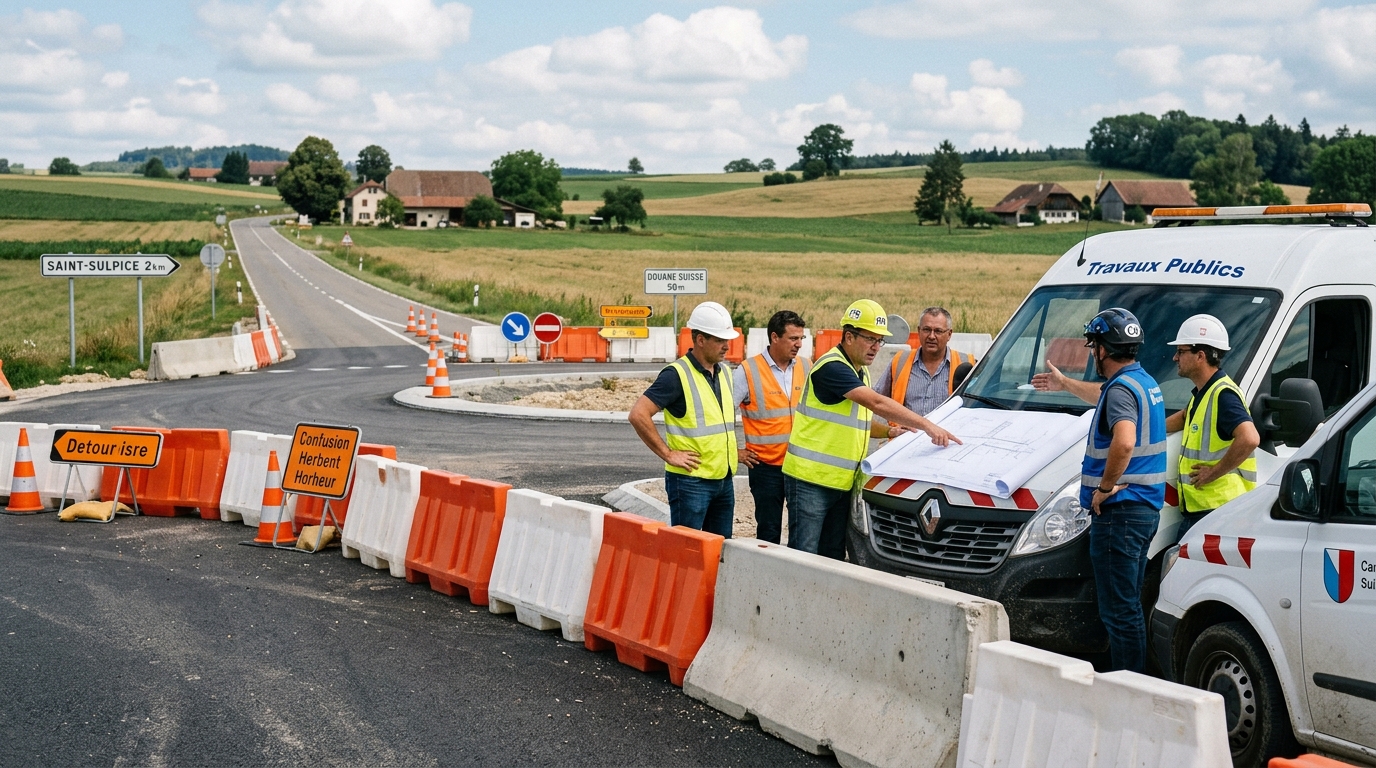
SAINT-SULPICE, France — The Joint Euro-Rhin Transport Commission entered its fifth year of formal arbitration Monday over the "La Cloche" roundabout, a 40-meter traffic junction on the Franco-Swiss border that has become entirely impassable due to an ongoing theoretical dispute between two regional engineering schools.
The conflict, which began during a routine resurfacing project in 2021, pits the French National School of Bridges and Roads (ENPC) against the Zurich Institute of Highway Dynamics. At stake is whether the intersection should operate as a French-style turborond-point with continuous spiral lane-shifting, or a traditional Germanic double-ring concentric circle with passive deceleration curbs.
Unable to reach a consensus, the commission’s governing board has spent the last 52 months implementing a series of temporary, bi-weekly compromises. Under the current "alternating design protocol," the roundabout is completely repainted every Sunday night. French spiral markings govern the tarmac from Monday through Wednesday, while Swiss concentric regulations are applied for the remainder of the week.
"It is a matter of geometric integrity," said Dr. Beatrix Keller, lead Swiss representative on the commission, speaking from the mobile observation trailer parked on the roundabout’s central concrete island. "The French model relies on predictive driver psychology, which is inherently unstable. Our concentric design enforces compliance through physical geometry. To abandon the concentric ring is to abandon the rule of law."
The rapid cycling of layouts has created a complex topographical hazard. The asphalt now bears 14 overlapping layers of conflicting thermoplastic paint, creating highly textured ridges up to three inches thick. Local motorists report that the physical vibration of driving over the competing white and yellow lines now mimics the sensation of traveling over rumble strips, regardless of the vehicle's direction of travel.
"On Thursdays, you must yield to the left, but if there is still wet blue paint from the Tuesday French configuration, you must follow the blue line into the neighboring bakery parking lot," said local commuter Marc Dubois, whose daily delivery van has suffered three suspension alignments this year. "The worst is Friday afternoon, when the paint crews begin prepping the surface for the weekend transition. At that point, it is simply a field of white noise."
French chief engineer Jean-Pierre Laurent dismissed Swiss concerns as "bureaucratic rigidity dressed up as physics." Laurent’s faction recently filed a formal injunction at the European Court of Justice to halt the installation of a Swiss-designed central signpost, arguing that its Helvetica typeface lacks the necessary aerodynamic fluidity to guide drivers through a fluid spiral exit.
To prevent head-on collisions during the transition periods, a neutral Belgian safety firm has been contracted at an annual cost of €420,000 to manually direct traffic using hand signals. However, both engineering factions have criticized the flaggers for employing hand gestures that lack standardized geometric angles.
The commission's next scheduled vote is set for January 2027, though progress remains stalled. Last week, a subcommittee tasked with choosing the fabric for the mediation room's curtains was dissolved after failing to agree on whether the pattern's horizontal stripes should run clockwise or counter-clockwise.