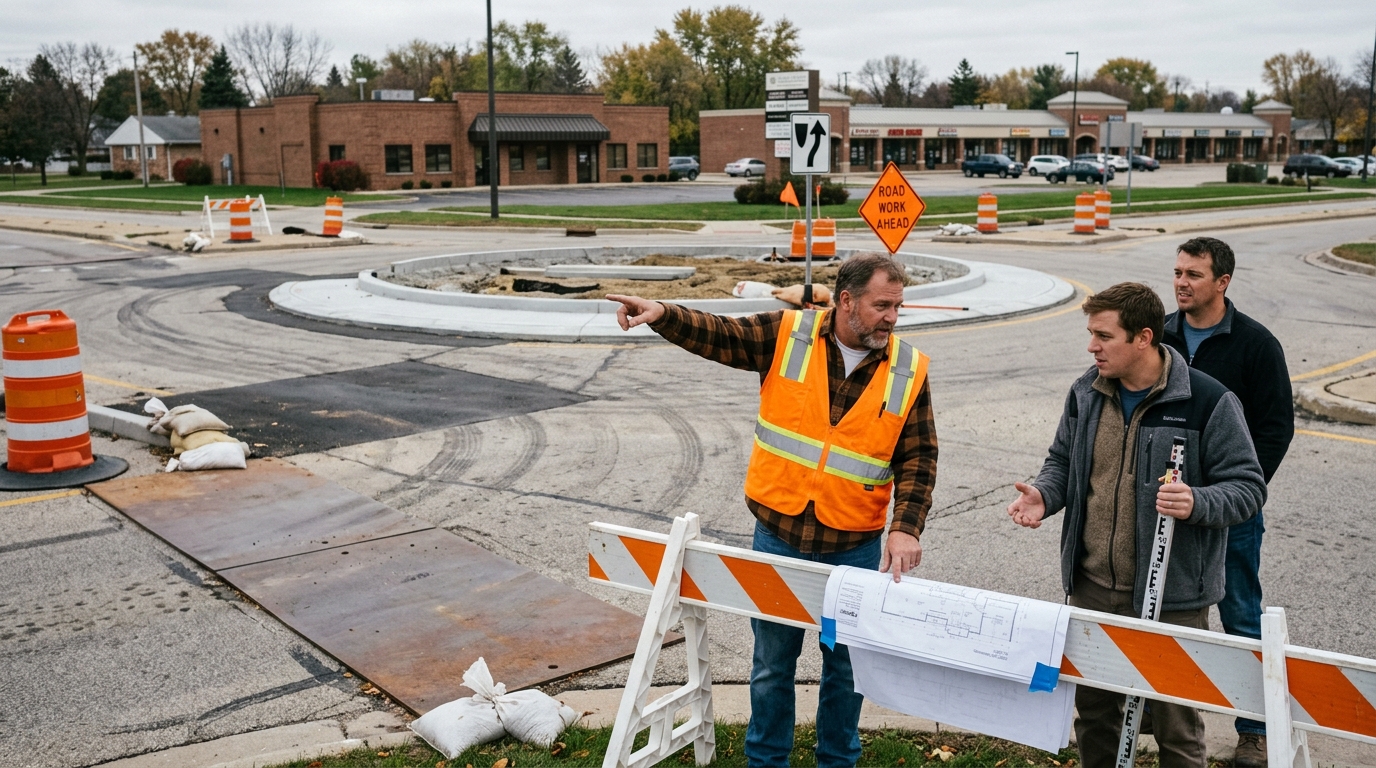
MIDDLETON, Wis.—What began as a routine traffic mitigation project at the intersection of County Road M and Stonecreek Lane has devolved into a multi-year academic proxy war, as two rival civil engineering philosophies continue to rewrite the physical geometry of the intersection on an almost weekly basis.
The Middleton Municipal Roundabout, originally commissioned in 2022 to ease school-zone congestion, has undergone 34 structural revisions in the last eighteen months alone. The frequent modifications are the result of an ongoing intellectual feud between the city’s contracted consulting firms, FlowState Logistics and the Institute for Kinetic Urbanism, each of whom holds alternating bi-weekly maintenance permits for the county.
At the heart of the dispute is a fundamental disagreement over human behavior. FlowState, led by chief designer Dr. Alistair Vance, champions the "Continuous Fluidity" model, which advocates for wide, sweeping curves that allow vehicles to maintain a constant 18 miles per hour. Conversely, the Institute for Kinetic Urbanism, guided by Dr. Meredith Finch, operates under "Friction-Induced Vigilance," a theory suggesting that drivers are only safe when they are actively terrified of hitting a curb.
"Dr. Vance’s design is a fantasy based on the assumption of rational actors," said Dr. Finch, standing near the roundabout’s southern approach, which currently features a newly installed 90-degree chicane designed to slow drivers to a crawl. "If you give motorists a smooth, continuous curve, their minds wander. They think about their grocery lists. By introducing what we call 'spatial hostility'—such as this three-inch curb lip—we force them back into the present moment."
The practical result for Middleton residents is a daily commute that requires active physical reconnaissance. On any given Monday, drivers might find the roundabout’s central island expanded by four feet to encourage "centrifugal compliance," only to return on Thursday to find the island shaved down and replaced with three concentric rings of high-visibility rumble strips.
"I’ve had to re-align my steering column twice this year," said local commuter Aris Thorne, who passes through the intersection daily on his way to work. "Last month, they changed the lane markings from solid white to a series of dashed blue lines that apparently signified a 'soft yield.' Nobody knew what it meant, so we all just parked and looked at each other for ten minutes."
The conflict shows no signs of abating. Under the current municipal framework, both firms are locked into a rolling ten-year service contract, with each modification classified as a "routine seasonal calibration," which bypasses the need for city council approval.
Last week, Vance’s team filed a 400-page injunction protesting Finch’s installation of a "tactile deceleration apron" made of recycled glass, calling it "an offense to the laws of laminar flow." In response, Finch’s firm has proposed adding a secondary, nested inner circle to the roundabout to test a theory she calls "recursive navigation."
Middleton Mayor Robert Chen expressed mild exhaustion when asked about the ongoing adjustments. "We just wanted a stop sign," Chen said. "But at this point, the legal fees to terminate either contract would cost more than the entire county highway budget. We’ve advised residents to simply leave for work twenty minutes earlier and to avoid looking the engineers in the eye if they are holding measuring tapes."