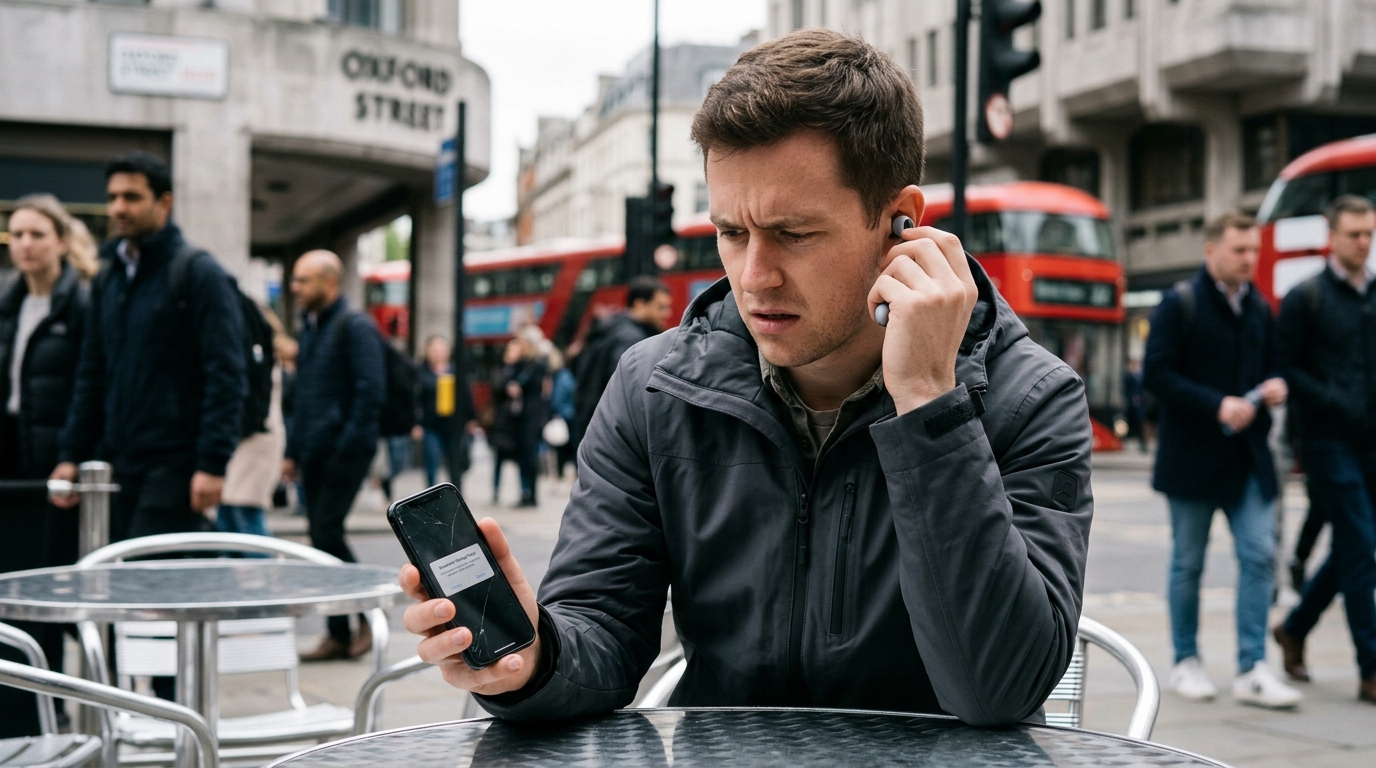
COLUMBUS, Ohio — A temporal researcher from the mid-22nd century who successfully crossed the space-time continuum to study early-21st-century civilization has abruptly suspended his historic mission, citing an inability to reliably pair his personal audio device with a rental sedan.
Dr. Caleb Vance, a Senior Chrono-Sociologist at the Neo-Geneva Institute of Applied Physics, arrived in a suburban Ohio parking lot on Tuesday afternoon through a localized gravity rift. However, academic sources confirm that Dr. Vance’s primary objective—observing the transitional economic models of the late 2020s—was permanently derailed within twenty minutes of his arrival by a standard-issue 2024 Hyundai Elantra infotainment system.
"We engineered a stabilized wormhole using three gigawatts of directed muon energy, yet your primitive short-range radio frequency protocol requires me to repeatedly toggle my auditory implant's visibility settings," a visibly exhausted Vance told reporters before initiating his return sequence. "I spent forty-five minutes sitting in a humid asphalt lot while a low-resolution screen informed me that 'Pairing Failed' because of an unspecified keypass mismatch. It is an unlivable era."
According to witnesses at the scene, Vance’s frustration escalated when he attempted to clear the vehicle’s cache of previously connected devices. The system reportedly refused to delete a device named "Scurry’s iPhone 13 Mini" without a master PIN, which the rental agency had not provided.
"He was muttering about the 'barbarism of the 2.4 gigahertz band' and asking why there wasn't a universal neural handshake," said Marcus Thorne, an assistant manager at the rental office who assisted Vance. "I told him he could try the auxiliary cord, but his head didn't have a 3.5-millimeter jack. I suggested he turn his brain off and back on again, but he said that would cause a localized memory paradox."
Records indicate that Vance’s mission was intended to last three weeks, during which he was scheduled to collect soil samples and archive digital media from the pre-fusion era. Instead, Vance spent his entire 36-hour stay attempting to play an ambient relaxation track through the car’s speakers to soothe a temporal-displacement headache.
The incident highlights a growing consensus among theoretical physicists that while humanity may eventually master the manipulation of four-dimensional space, the seamless handoff of audio data between two commercial microchips remains an insurmountable barrier.
"I have witnessed the construction of the first Dyson Swarm," Dr. Vance said, adjusting the copper-alloy dial on his wrist. "But I have never experienced anything as demoralizing as watching a digital hourglass spin indefinitely while trying to play a podcast at a reasonable volume. You people live like animals."
Vance then activated his return beacon, vanishing in a flash of blue light that temporarily interfered with the local dealership's Wi-Fi network, forcing three sales representatives to restart their routers.