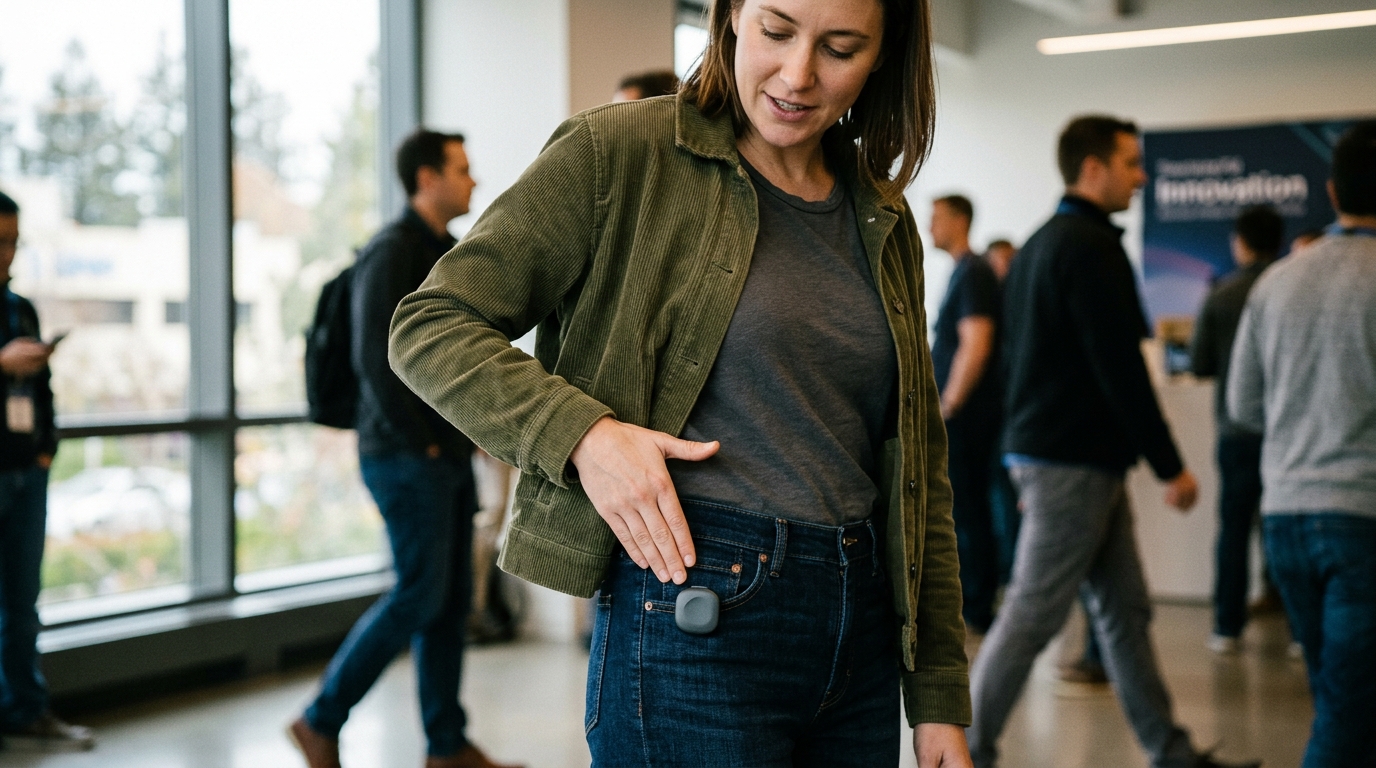
SAN JOSE, Calif. — Sept. 13, 2026 — Silicon Valley hardware startup Loomis Labs announced Thursday the release of the Tri-Pat Active, a $189 wearable sensor designed to monitor, analyze, and optimize the manual physical gestures users perform to verify they have their phone, keys, and wallet.
The device, which clips onto the wrist or index finger, uses dual-axis accelerometers to measure the speed, deceleration, and impact force of the traditional "three-point check." According to promotional materials, the Tri-Pat Active aims to eliminate "micro-frictional delays" in daily transit by streamlining the physical reassurance tap into a singular, highly efficient motion.
"For decades, the pocket pat has been treated as a subconscious, unmeasured reflex," said Marcus Vance, chief executive of Loomis Labs, during a keynote presentation streamed from the company’s headquarters. "But our research shows that the average urban commuter performs up to forty-two redundant, low-velocity pats per day. By digitizing this tactile loop, we can reduce total daily pat-time from eight seconds to a lean 1.4 seconds."
The accompanying smartphone app categorizes user performance into three proprietary metrics: Pat Latency (the time elapsed between standing up and initiating the first tap), Force Consistency (ensuring the hand strikes the fabric with sufficient force to register the object without causing bruising), and the False Alarm Rate (unnecessary taps prompted by phantom vibrations). Users who achieve a "perfect pat sequence" are rewarded with a soft haptic chime and a "Pat-Score" of 95 or higher, which can be shared on professional networking platforms.
Early beta testers report that while the device successfully quantifies their anxiety, it also introduces new behavioral protocols.
"Before the Tri-Pat, my morning routine was chaotic—I would just slap my hips haphazardly," said Clara Higgins, a senior systems analyst from Sunnyvale. "Now, I follow a strict, linear diagonal-swipe pattern recommended by the app. My latency is down 40 percent, though I did have to buy new trousers with thinner pocket lining so the sensor could accurately register my car keys."
Industry analysts have questioned the market viability of a dedicated sensor for a task that has historically cost consumers nothing. However, Loomis Labs plans to expand the ecosystem with a $9.99 monthly subscription service called PatPlus. The premium tier unlocks "Predictive Pocket Diagnostics," which uses machine learning to anticipate when a user is about to pat their pockets based on their proximity to an exit door, pre-emptively vibrating to save them the physical effort of the pat entirely.
The company has already announced its next-generation model, which will feature a small adhesive patch for the lower thigh. The patch is designed to resolve a common issue identified during product testing: users frequently losing the Tri-Pat Active itself, requiring a new, four-point pat sequence to verify the presence of the sensor meant to verify the presence of everything else.