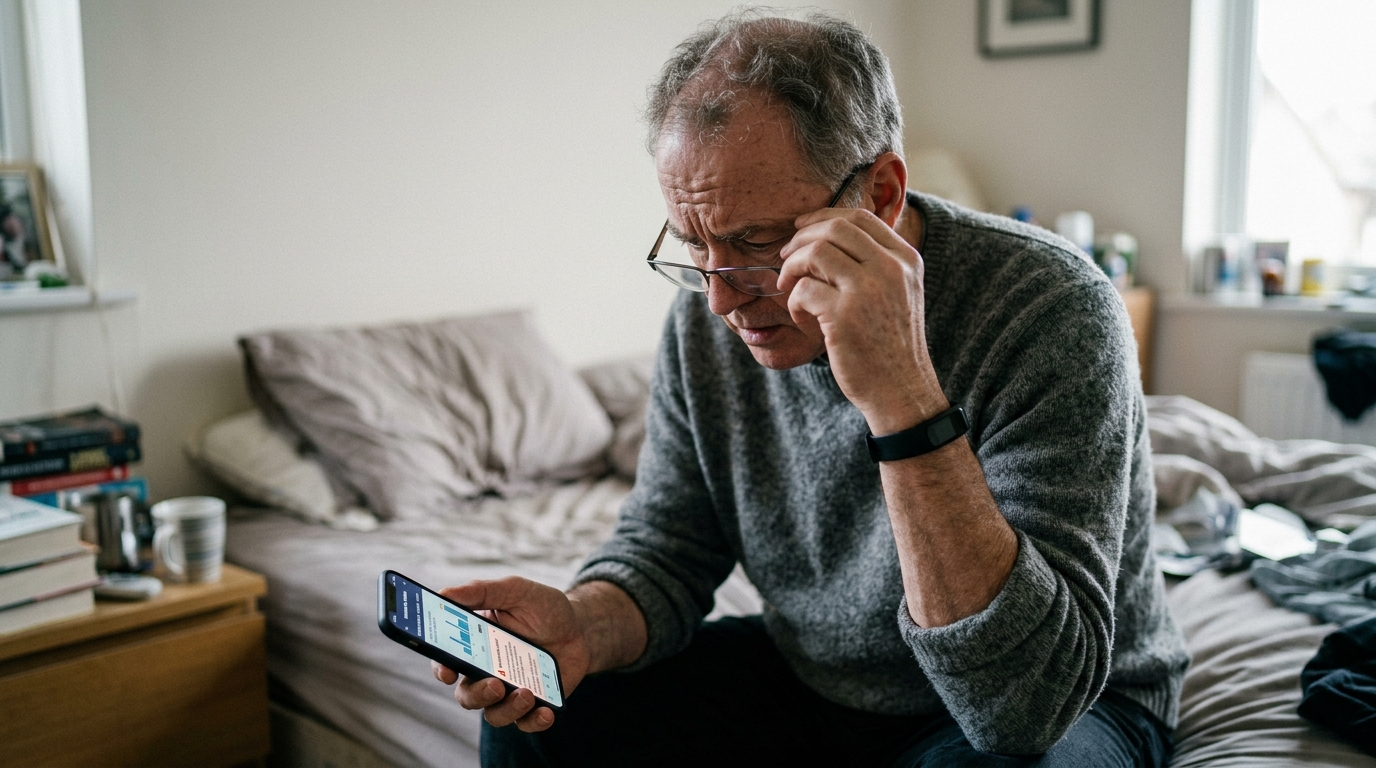
SEATTLE — A major software update to the market-leading Somnus Pro sleep tracker has drawn criticism this week after users reported receiving automated notifications reprimanding them for the thematic content of their dreams.
The firmware update, designated Version 8.4 or "Nocturnal Alignment," introduces biometric narrative analysis. According to product documentation, the wearable device now cross-references rapid eye movement (REM) patterns and heart-rate variability with neural cognitive profiles to evaluate whether a user’s dreaming state is actively contributing to their waking productivity.
For many users, the update has resulted in early-morning push notifications criticizing their subconscious choices.
"I woke up on Tuesday to an alert telling me my sleep quality was compromised by 'narrative stagnation,'" said Amanda Chen, a senior financial analyst based in Bellevue, Washington. "According to the app, I spent 42 minutes of deep REM dreaming about trying to find a classroom in a high school I graduated from twenty years ago. The app flagged it as a 'non-value-adding cognitive loop' and docked my daily readiness score by fifteen points."
The Somnus Pro dashboard reportedly advised Chen to review her professional quarterly goals before bed to "curate a more forward-looking cognitive landscape."
Somnus Labs, the Silicon Valley startup behind the $400 wearable, defended the update in a press release on Wednesday. The company stated that passive dreaming represents a significant bottleneck in human capital optimization.
"We have spent years tracking how people sleep, but until now, we ignored what they were doing while sleeping," said Dr. Helen Vance, Vice President of Cognitive Hygiene at Somnus Labs. "If a user spends eight hours rendering a scenario where their teeth fall out, they are returning to the workforce with a compromised mental architecture. Our goal is to steer the subconscious toward constructive processing, such as spatial geometry, strategic planning, and conflict resolution."
To help users correct "divergent dream behavior," the updated app now offers "Active Narrative Interventions"—a premium subscription tier that plays targeted binaural frequencies to redirect dreams that deviate from high-performance parameters.
Some users, however, feel the device is overstepping. Robert Diaz, a civil engineer from Portland, Oregon, reported that his Somnus Pro threatened to lock his smart-coffee maker integration after he repeatedly dreamed of flying over a cartoonish forest.
"The app told me that gravity-defying escapism is a symptom of low task-adherence," Diaz said. "It suggested I replace the flying dreams with a simulation of my current project pipeline. I tried to explain to the customer service chatbot that I can't control what I dream, but it just sent me a PDF on sleep discipline."
Despite the pushback, Somnus Labs plans to expand the feature. An upcoming patch will allow corporate enterprise accounts to sync employee dream-efficiency scores directly to HR performance dashboards, ensuring that staff remain aligned with company culture even during periods of deep unconsciousness.