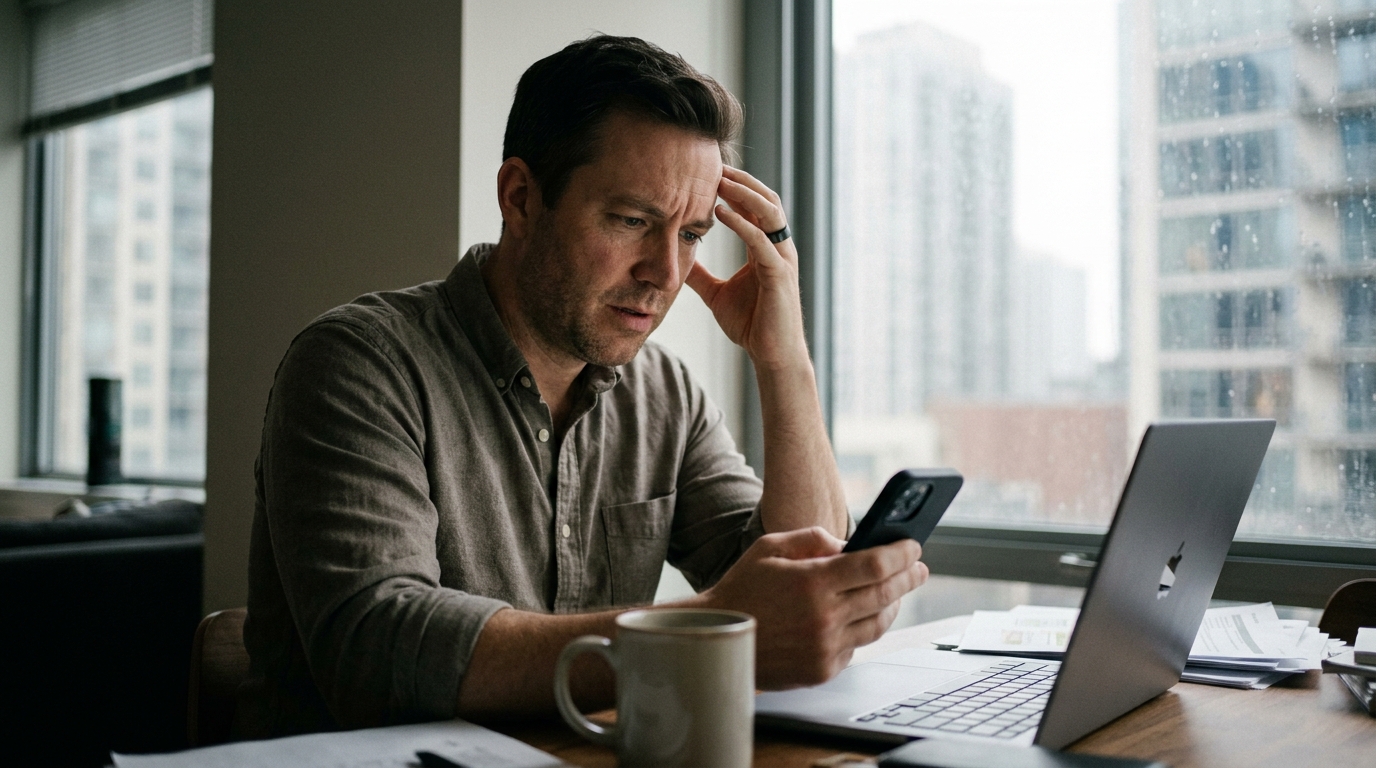
CHICAGO — A local consultant is facing consecutive “sub-optimal subconscious integration” warnings from his sleep tracker after his nightly REM cycles failed to align with his professional productivity goals.
Marcus Vance, 34, received his first alert on Thursday morning from the Somnura Ring Gen-4, a wearable device that recently introduced a firmware update called DreamOptima. According to product documentation, the update uses micro-EEG sensors to analyze the cognitive utility of a user’s dreams, grading them against high-efficiency neurological archetypes.
"I woke up expecting my usual readiness score, but the app gave me a yellow warning screen," Vance said. "The notification told me that my REM cycle at 3:14 a.m. was dominated by a 'low-utility nostalgia loop.' Specifically, I was dreaming about trying to find my locker in a middle school that had been converted into a library."
According to the Somnura app, Vance’s dream represented an 18 percent decline in active cognitive synthesis compared to his demographic peer group. The device recommended that Vance steer future subconscious activity toward "forward-facing spatial navigation" or "strategic asset allocation."
The update has sparked a quiet debate among wellness enthusiasts who feel the pressure of the workday is encroaching on their unconscious hours. However, Somnura executives defend the feature as a natural evolution in human optimization.
"Unstructured REM sleep is the last remaining frontier of human waste," said Dr. Evelyn Carter, Vice President of Subconscious Optimization at Somnura. "When you dream about your teeth falling out, or being chased by a generic shadow, your brain is essentially spinning its wheels. DreamOptima helps users identify when their sleeping minds are indulging in legacy anxieties rather than processing useful data."
Carter noted that the software is designed to gently nudge users toward more productive sleep-state narratives. For premium subscribers, the ring uses subtle haptic vibrations during REM sleep to disrupt recurring, unprofitable dream tropes.
"If the algorithm detects a recurring theme of being unprepared for a presentation, it can emit a 4-hertz pulse to encourage the dreamer to either complete the presentation successfully in-system, or pivot the dream toward a low-stress networking event," Carter said.
For Vance, the corrective feedback has only added to his nighttime anxiety. He spent Sunday evening reading logistics reports in an attempt to seed his subconscious with high-value imagery, only to be flagged again on Monday morning.
"I tried really hard to dream about supply chain management," Vance said, reviewing his morning diagnostic report, which labeled his sleep 'unfocused.' "But about an hour before waking up, a talking golden retriever showed up and we went to a diner. The app docked me ten points for 'unauthorized whimsical intervention.' I had to drink three coffees just to feel allowed to sit at my desk."