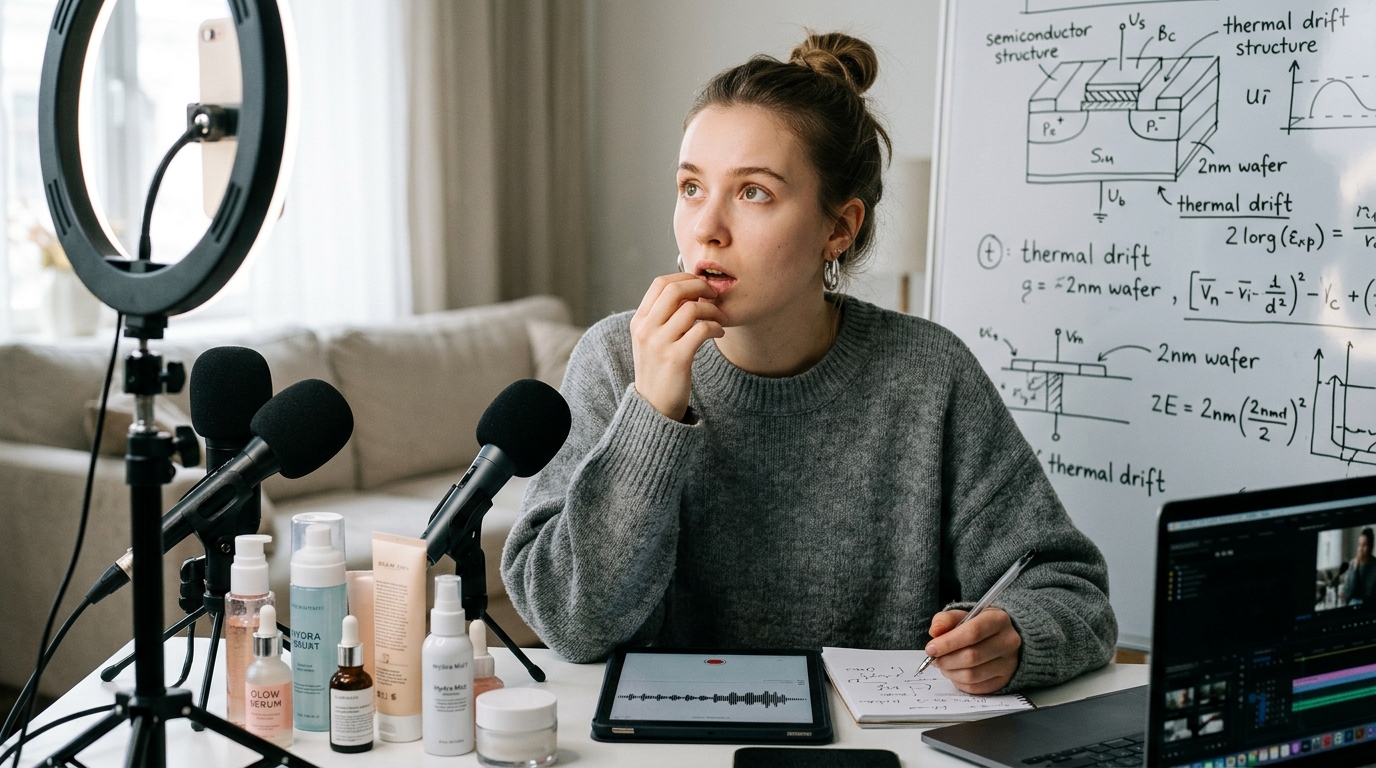
SAN JOSE, Calif.—The semiconductor industry’s premier technical conference opened Tuesday with a keynote address from lifestyle influencer Sienna Brooks, whose viral skincare tutorials have unexpectedly become the foundation for next-generation silicon wafer lithography.
Brooks, 24, who operates the lifestyle channel "Glow by Sienna," was invited to address the International Symposium on Micro-patterning after her 10-part video series, titled "Sub-Nanometer Pore Alignment," accidentally resolved a decade-long bottleneck in microchip manufacturing.
Originally intended as a tutorial for a clay-based facial mask and a blue-light therapy wand, the videos went viral after an algorithmic categorization error placed them under the "Advanced Photolithography" feed on several major video platforms. Silicon design engineers quickly noticed that Brooks’s intuitive approach to skin barrier maintenance offered a flawless mathematical solution to thermal drift in extreme ultraviolet (EUV) light systems.
"For years, we struggled with molecular degradation during high-intensity silicon exposure," said Dr. Raymond Vance, director of the Microelectronics Research Initiative, who attended the keynote. "When Ms. Brooks demonstrated her 'patting, never rubbing' technique to prevent epidermal irritation, we realized we could apply the exact same mechanical dampening principles to our robotic wafer-handling arms. It immediately improved our 2-nanometer chip yields by 18 percent."
In her videos, Brooks routinely uses terms like "silicon-based substrate," "chemical vapor deposition," and "debris extraction" to describe her morning exfoliation routine. While her 4.2 million followers understood these as beauty metaphors, research teams at Tokyo Electron and ASML began treating her videos as peer-reviewed instructional guides.
Brooks’s recommendation to "let the clay set completely before stripping the impurities" has already been adopted as the industry standard for photoresist baking times, saving manufacturers an estimated $400 million in material waste.
Brooks, who holds a bachelor's degree in communications and has never taken a physics class, remains relaxed about her sudden status as a titan of global supply chain technology.
"They kept asking me about my 'immersion depths' and whether I preferred dry or wet lithography," Brooks said from her dressing room, which was stocked with promotional silicon ingots. "I just told them that hydration is key, and that you always want a clean, dust-free environment. Apparently, that is a very big deal to men in polo shirts."
Industry leaders have moved quickly to cement Brooks’s place in the scientific community. She has already been credited as a co-author on four papers in the *Journal of Vacuum Science & Technology*, with her contributions transcribed verbatim from her Instagram Stories about lymphatic drainage.
On Thursday, the National Science Foundation announced a $12 million development grant for Brooks to oversee a new cleanroom research facility at Stanford University. Brooks confirmed she plans to use the funding to develop a line of monocrystalline quartz facial rollers that she claims will align both facial muscles and local electrical grids.