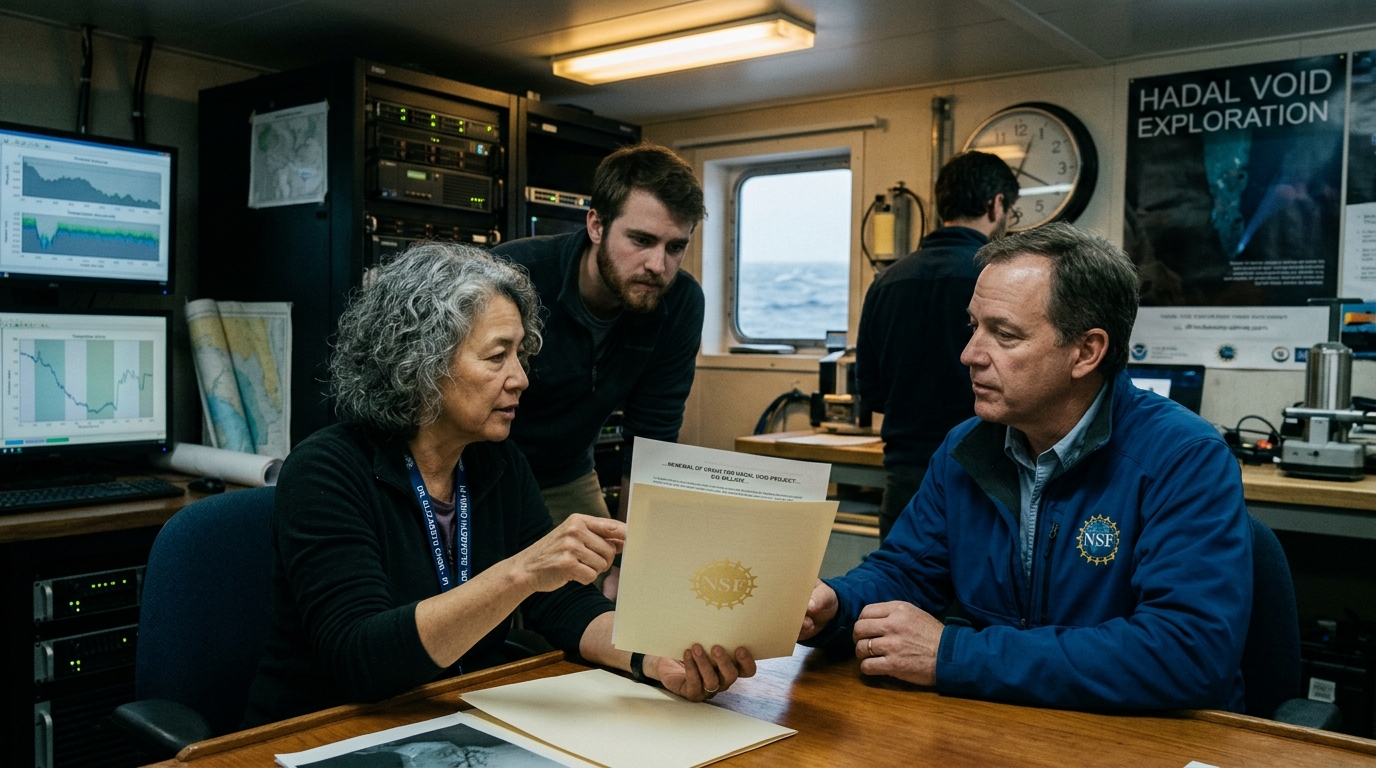
WOODS HOLE, Mass. — The Hadal Void Project, a joint deep-sea exploration initiative, has secured a three-year, $42 million grant renewal from the National Science Foundation (NSF) despite returning from its latest six-month voyage in the Pacific with zero biological, geological, or chemical samples of interest.
The crew of the research vessel R/V Sentinel completed 182 consecutive deep-sea descents using remote-operated vehicles (ROVs) in the southern Mariana Trench. Each dive returned with empty specimen canisters, sterile water samples, and thousands of hours of high-definition video footage of uniform, featureless grey silt.
While previous expeditions have struggled to secure funding after failing to discover new species or hydrothermal activity, the NSF’s peer-review panel lauded the Hadal Void team for its "unparalleled procedural hygiene" and the flawless predictability of its outcomes.
"Many deep-sea expeditions suffer from the disruptive interference of unexpected thermal vents or undocumented crustacean species," said Dr. Aris Thorne, the lead oceanographer of the project, speaking from the Woods Hole dock. "Our data stream was completely clean. From November through May, we achieved a state of pure, unadulterated absence. There was no noise, no signal, and absolutely no biomass to account for."
According to the NSF’s evaluation report, the project’s success lies in its perfect replication rate. In an academic landscape where scientific studies frequently struggle to produce reproducible results, the Hadal Void team achieved a 100% replication rate: every single dive produced the exact same lack of findings.
This level of bureaucratic and scientific consistency was a major selling point for the funding committee, which has recently faced pressure to back lower-risk, highly structured research.
"In modern research administration, predictability is paramount," said Dr. Eleanor Vance, director of the NSF’s Division of Ocean Sciences. "The Hadal Void team demonstrated a rigorous adherence to protocol. They did not allow the chaotic, unpredictable nature of the ocean to interfere with their pre-approved filing schedule. When a team promises to lower a $12 million camera into the dark and bring back nothing but dark, and they deliver exactly that, you renew them."
The new $42 million allocation will allow the team to upgrade the ROV’s hydraulic arms to more efficiently grab nothing, as well as install advanced "non-detection sensors" designed to rule out the presence of organic matter with greater statistical certainty. The project also plans to relocate its efforts to the Kermadec Trench, where preliminary sonar suggests an even more robust level of emptiness.
The project’s physical archive at Woods Hole currently consists of three rows of temperature-controlled steel shelving holding 400 empty, sterilized glass jars.
"Maintaining the precise vacuum seal on those jars requires about nine percent of our annual budget," Thorne said, gesturing to the silent, immaculate laboratory. "But if we let even a single microbe in there, the integrity of the last six months of work is completely ruined."