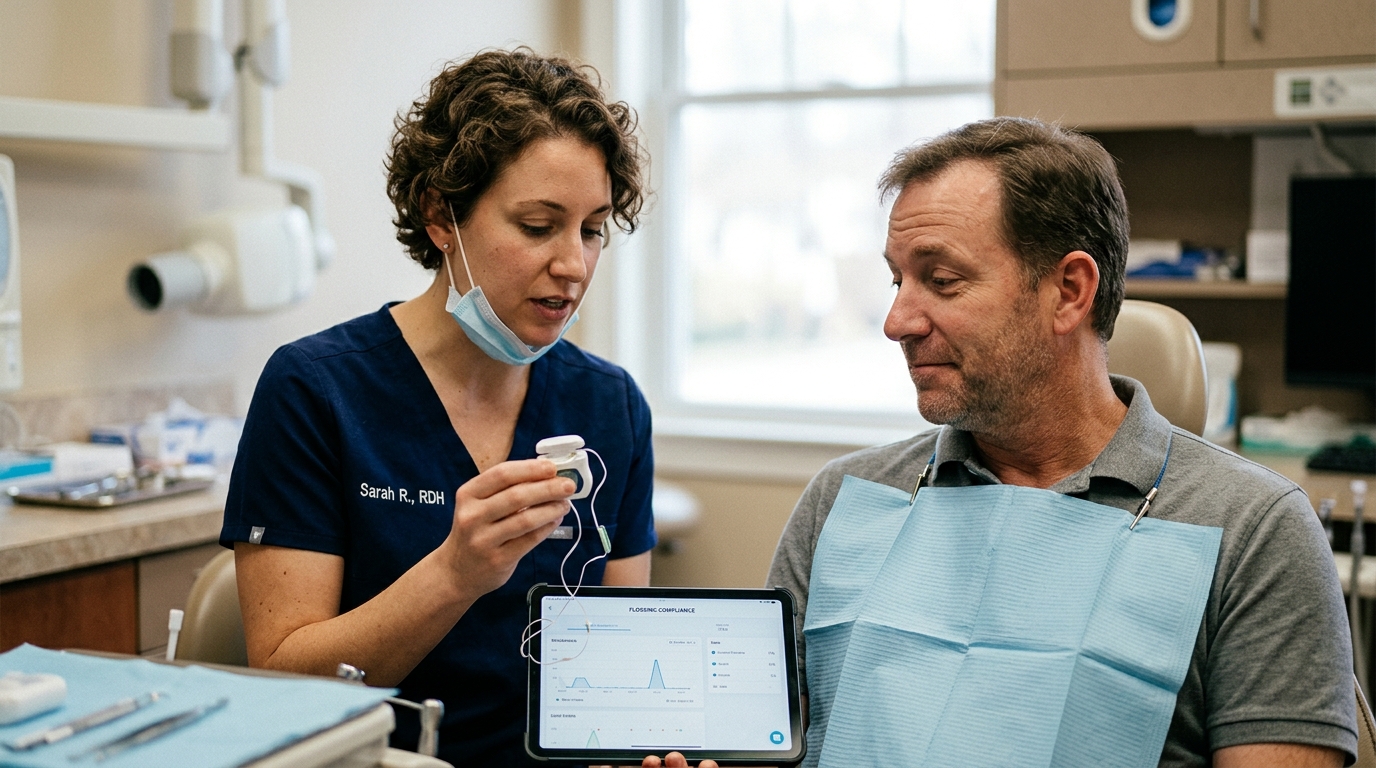
CLIFTON, N.J. — A local dental practice has successfully completed the first trial of a smart-dentistry monitoring program designed to eliminate patient dishonesty regarding daily flossing through real-time bio-sensor tracking and automated behavioral intervention.
Clifton Family Dental, which serves approximately 4,000 active patients in northern New Jersey, initiated the "TruePath Floss Initiative" in January. The program replaces standard waxed dental floss with FibraOptic-9, a proprietary monofilament embedded with micro-tensile sensors that transmit tension, friction, and moisture data to an encrypted clinic database.
When a patient pulls a length of floss from the Bluetooth-enabled dispenser, the system logs the event. If the floss does not make contact with interdental papilla within six minutes, the dispenser flags the action as a "dispensation without application" and logs a compliance deficit.
"For decades, the patient-dentist relationship has been built on a foundation of polite, mutual fiction," said Dr. Evelyn Vance, DDS, lead partner at the practice. "Patients sit in our chairs and claim they floss twice a day, and we look at their bleeding gums and pretend to believe them. FibraOptic-9 removes the emotional labor of lying from the patient's day entirely. We now have the telemetry."
For patients like Arthur Pendelton, 42, a logistics coordinator from nearby Montclair, the technology has fundamentally altered his evening routine. Pendelton, who currently holds an "Interproximal Integrity Score" of 64 percent, described the system's escalating feedback loop as highly effective, if emotionally taxing.
"If I don't lift the dispenser lid by 10:30 p.m., my phone buzzes," Pendelton said. "It is never an angry text. It’s just a picture of a healthy, pink gumline with the caption: 'Thinking of you.' If I ignore that, I get an automated voicemail at 7:00 a.m. the next morning from Dr. Vance asking if my hands are feeling okay today. It’s deeply exhausting, but my pocket depths have decreased by two millimeters."
The program was developed in collaboration with the Rutgers University Department of Applied Behavioral Psychology. Researchers designed the automated messaging system to leverage what they call "low-grade, persistent professional disappointment"—a psychological lever proven to be more effective than traditional medical warnings about bone loss or cardiovascular risk.
According to Dr. Aris Thorne, a behavioral economist who consulted on the project, traditional health warnings trigger cognitive bias and denial. By contrast, passive-aggressive digital interventions bypass defensive mechanisms by targeting the patient's desire for approval.
"We found that showing patients images of advanced periodontal disease did nothing to change behavior," Dr. Thorne explained. "But when a patient receives a text message saying, 'We noticed your upper-right bicuspids have been quiet for 48 hours; hope everything is well on your end,' compliance rates spike by nearly 87 percent within twenty minutes."
For patients whose compliance falls below the 40th percentile, the system automatically escalates its interventions. Clifton Family Dental has begun mailing physical postcards to low-compliance households. The postcards contain simple recipes for soft foods, such as applesauce and pureed butternut squash, accompanied by a handwritten signature from the dental hygienist reading, "Just planning ahead."
While some privacy advocates have raised concerns regarding the collection of daily biometric data, Dr. Vance insists the program is entirely voluntary. However, patients who opt out of the FibraOptic-9 system are subject to what the clinic calls "High-Risk Manual Verification" during their standard biannual cleanings.
"Patients are welcome to return to traditional, unmonitored floss," Dr. Vance said. "But they should understand that we will have to conduct a much more thorough, silent manual probe. During this process, our hygienists are instructed to sigh audibly every twelve to fifteen seconds while looking at the ceiling. Most patients find the smart floss to be the more comfortable option."
On a recent Thursday afternoon, Pendelton sat in the Clifton Family Dental waiting room for his six-month checkup, clutching his smartphone. He admitted to flossing four times in his car in the parking lot in an attempt to artificially inflate his weekly average, though he suspected the database would recognize the sudden burst of activity.
"They call it 'panic-flossing' in the patient portal," Pendelton whispered, looking warily at the receptionist. "I just got a notification while I was walking in. It said, 'We see you trying.' I don't think I'm getting a complimentary toothbrush today."