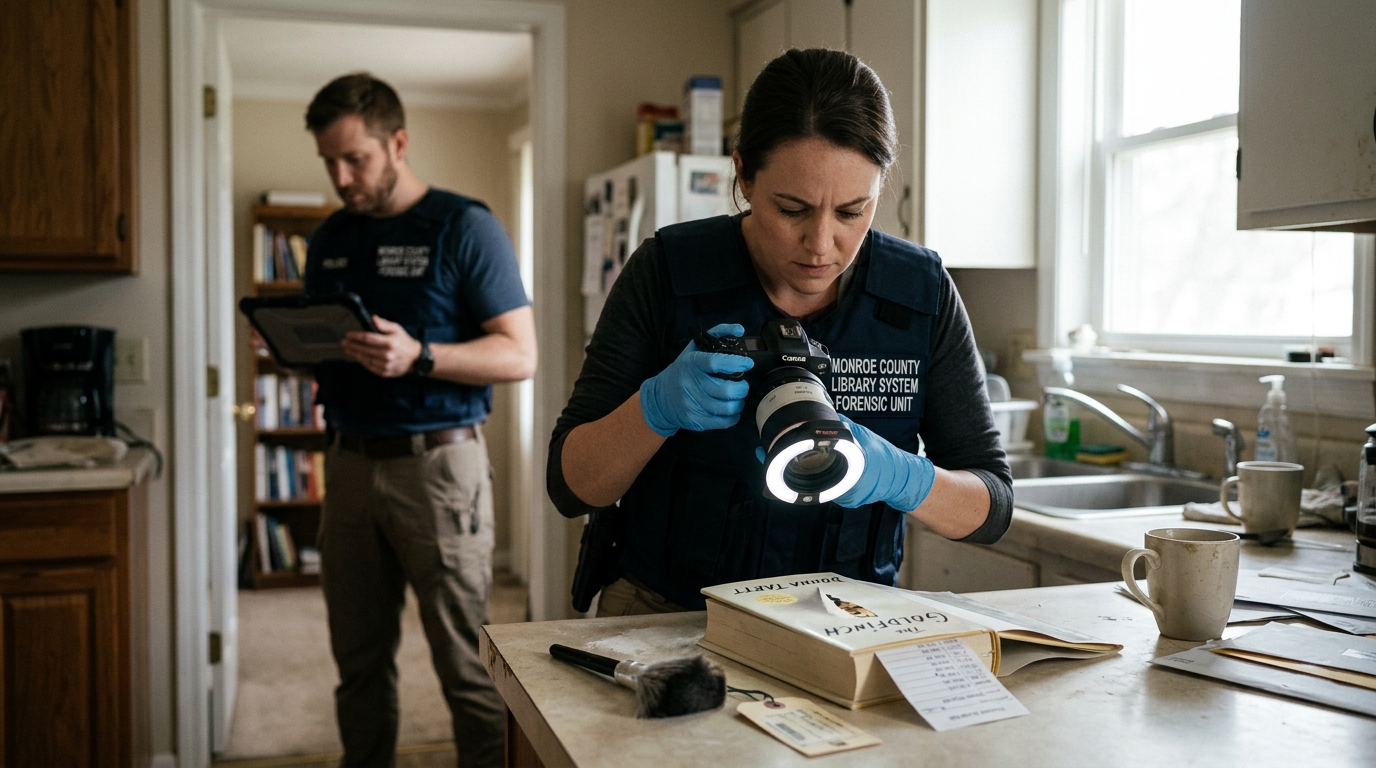
BLOOMINGTON, Ind. — The Monroe County Public Library system has officially transitioned its circulation services department into a fully operational forensic recovery division, introducing tactical knock-and-announce visits and DNA analysis of returned bookmarks to combat a rising tide of overdue paperbacks.
Under the newly enacted "Zero-Loss Literacy Initiative," the library has abandoned traditional email and postcard reminders. Instead, cardholders whose borrowed materials are more than 14 days overdue are categorized as "Active Resisters of Return" (ARRs). Their files are immediately transferred to the library’s newly established basement facility, a high-security space formerly reserved for the storage of historical microfiche.
Arthur Pendelton, a 43-year-old actuary and lifelong resident, experienced the policy shift firsthand on Tuesday morning. At approximately 5:45 a.m., he was awakened by three uniformed recovery agents standing on his porch. His offense was a copy of *A History of the Salt Trade* (1998), which had been due on August 24.
"They didn't use a battering ram, but they did have a megaphone," Pendelton said, recalling the incident while sitting in his living room. "They announced they had a municipal warrant for the extraction of one octavo-format hardcover. They asked me to step away from my bookshelves and keep my hands where they could see them."
According to Monroe County Library Chief of Asset Preservation Diane Vance, the escalation was a necessary response to decades of soft-handed enforcement. "For years, the public has treated library materials as a casual loan rather than a binding civic contract," Vance said, standing near a wall of seized paperbacks currently undergoing cataloging. "A book is municipal property. If you drove a city-owned street sweeper home and kept it in your driveway for three weeks, there would be an investigation. This is no different."
The recovery division now employs two specialized K-9 units trained to detect the unique chemical signatures of decaying wood pulp, binding glue, and mylar book jacket covers. Additionally, the library has established a "Most Owed" list on its homepage, featuring redacted library card barcodes and pixelated security footage of patrons leaving the building with thick volumes of historical fiction.
The initiative has drawn some criticism from local civil liberties advocates, who argue that deploying tactical teams to retrieve $14.99 paperbacks is a disproportionate use of public funds. However, the library board noted that the program has already recouped $1,200 in physical assets, offset by approximately $84,000 in tactical gear and overtime pay.
For Pendelton, the ordeal ended with a $4.50 overdue fine and an additional $180 "tactical deployment surcharge." He has since transitioned entirely to digital e-books, though he remains cautious. "I still check my tablet twice a night to make sure the license hasn't expired," Pendelton said. "I don't want them coming back for the pixels."