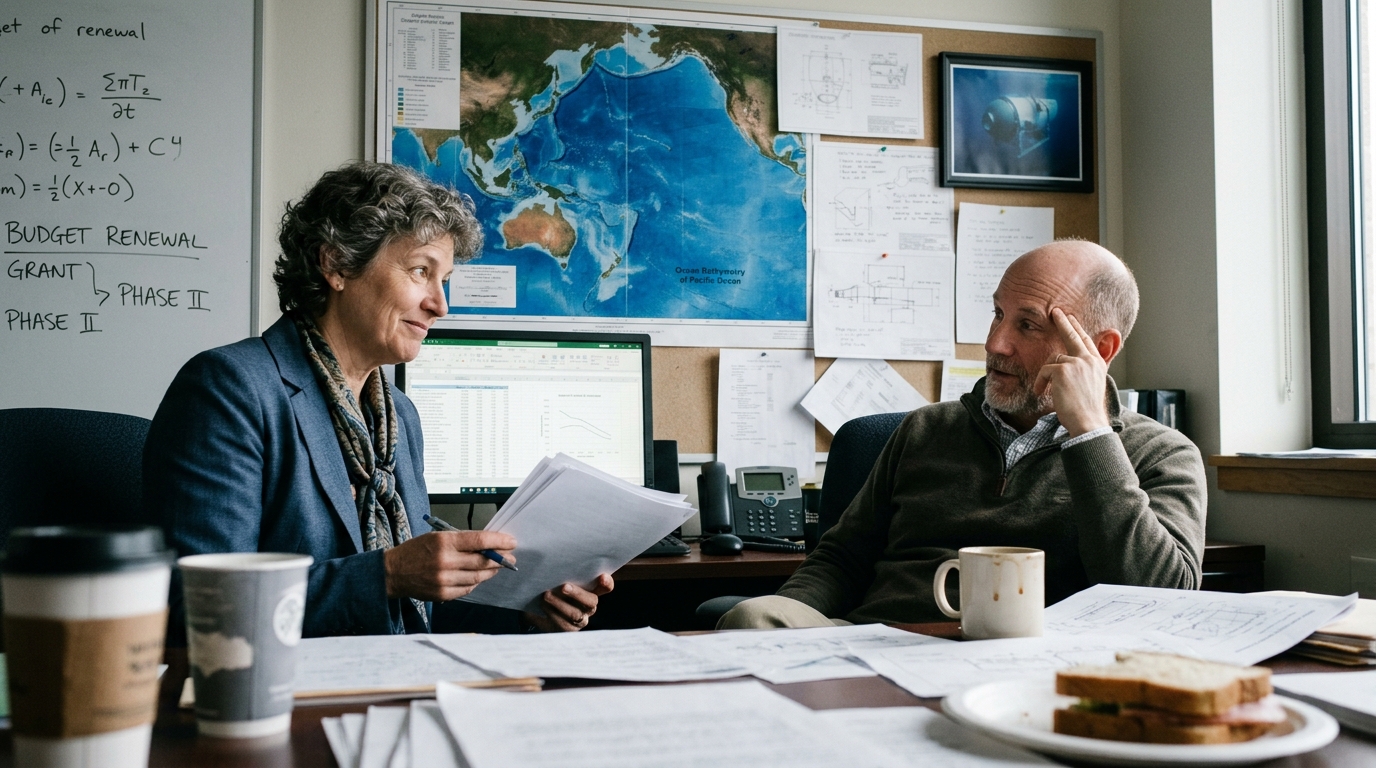
SEATTLE — Sub-Venture Partners, a private oceanographic exploration firm, has secured a record $42.6 million Series B funding renewal from the Blue Horizon Syndicate, despite its latest 18-month deep-sea expedition returning entirely empty-handed.
The expedition, code-named "Project Abyssal Null," spent 512 days mapping a 4,000-square-mile sector of the Kermadec Trench. According to the firm’s final 800-page report, the mission yielded no rare-earth mineral deposits, no novel biological species, and no thermal anomalies. Instead, the team documented a highly consistent, uniform expanse of fine gray silt.
"We are thrilled with the absolute purity of the data," said Dr. Alistair Finch, Chief Science Officer of Sub-Venture Partners, speaking from the firm’s dockside headquarters. "To lower a multi-million-dollar sensor array to a depth of 30,000 feet and find absolutely nothing of commercial, ecological, or historical interest requires an extraordinary level of methodological discipline. A lesser team would have accidentally drifted into a hydrothermal vent or tripped over a new species of amphipod. We maintained perfect spatial exclusion."
Industry analysts noted that the funding renewal reflects a growing appetite among venture capitalists for "highly predictable negative outcomes." In a volatile economic climate, the complete absence of findings represents a stable, low-risk asset class free from the regulatory hurdles, ecological protests, and patent disputes that typically follow major scientific discoveries.
Brenda Vance-Gomez, Managing Partner at Blue Horizon Syndicate, praised Sub-Venture's strict adherence to its "Zero-Yield Framework."
"When we invest in deep-sea exploration, we are looking for certainty," Vance-Gomez said. "An unexpected discovery of, say, a bioluminescent organism or a cobalt crust creates immediate regulatory complications with the International Seabed Authority. Sub-Venture promised us a blank slate, and they delivered exactly that, on time and under budget. It is the cleanest portfolio asset we currently hold."
The crown jewel of the expedition was the Nadir Explorer, a $14 million autonomous underwater vehicle equipped with high-definition 4K cameras and laser-induced breakdown spectrometers. Over the course of 3,000 hours of continuous footage, the vehicle recorded nothing but suspended marine snow and undisturbed mud.
To process the vast amount of non-information, Sub-Venture developed a proprietary machine-learning algorithm called VoidMapper, which verified with 99.98% confidence that the gray silt in hour 2,000 was identical to the gray silt in hour one.
With the new $42.6 million capital injection, Sub-Venture plans to construct the Nadir Explorer II. The upgraded vessel will feature advanced deep-sea vacuum systems designed to ensure that even if microscopic life forms are present in future target zones, they will not be captured in the sampling chambers, thereby preserving the integrity of the firm's non-discovery pipeline.
"Our goal for the 2027 season is to expand our non-findings into the adjacent basin," Dr. Finch said. "We want to be able to tell our partners with absolute authority that there is nothing down there, as far as the eye can't see."