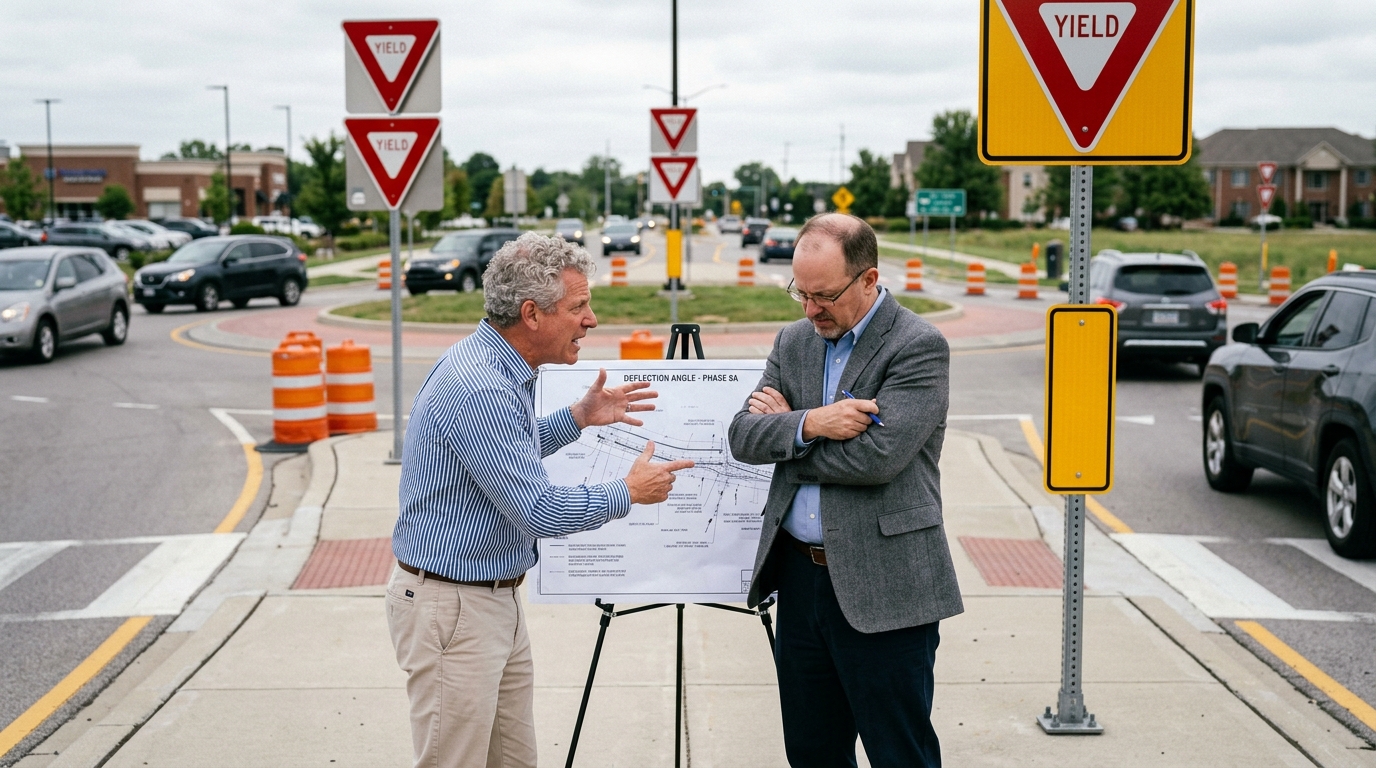
CARMEL, Ind. — For the fourth time this fiscal year, orange construction barrels have returned to the intersection of 116th Street and Keystone Parkway, marking the latest escalation in an eight-year ideological feud between the county’s two chief transit planners.
What began in 2018 as a routine intersection upgrade has devolved into a highly technical, multi-million-dollar battle of wills between Dr. Aris Thorne, a proponent of classical European radial deflection, and Marcus Gentry, the county’s senior engineer of continuous-flow dynamics. The resulting roundabout now features three concentric lanes, nine yield points, and a contested bypass slip lane currently blocked by a temporary water barrier pending a judicial review.
“Dr. Thorne’s insistence on a tight 120-foot central island radius is academically elegant but practically stagnant,” said Gentry, standing near the intersection with a laser level and a binder of hydraulic simulation data. “It forces a deceleration rate that borders on the polite. My design prioritized kinetic release. If we had kept the northern tangential bypass, drivers would be clearing the circle at 34 miles per hour, as God intended.”
Thorne, who has twice petitioned the state Supreme Court to halt Gentry’s concrete pours, rejected the critique.
“Mr. Gentry’s continuous-flow model is not civil engineering; it is a high-speed centrifugal playground,” Thorne said. “A successful roundabout must demand cognitive labor. If a commuter can traverse this circle without experiencing a brief, healthy spike in cortisol, the deflection angle is insufficient.”
Local motorists have found themselves caught in the crossfire of the academic standoff. The intersection’s signage has been altered 14 times since 2022, occasionally overnight. At present, the eastern entrance requires drivers to yield to vehicles already in the circle, while the western entrance features an experimental "reverse-priority" yield sign installed by Gentry’s team during a weekend shift in April.
The confusion has turned the suburban junction into an object of fascination for regional academics. Purdue University’s Department of Civil Engineering recently installed a permanent webcam overlooking the circle to study "acute vehicular hesitation."
“It’s become a rite of passage,” said resident Clara Sterling, who passes through the circle daily to reach her office. “Last month there was a physical barrier forcing us into a single lane, which Dr. Thorne’s newsletter called 'forced mindfulness.' Yesterday, they paved over the median and added a third lane that just sort of ends in a pile of gravel. I’ve started taking the highway, even though it adds twenty minutes to my drive.”
Despite mounting public frustration, the Carmel Town Council has demurred from intervening, citing a 2019 collective bargaining agreement that grants both engineers equal, non-overlapping veto power over municipal pavement geometry.
As of Friday, a new crew was spotted unloading concrete forms near the southern curb. According to municipal permits, Thorne has secured funding for a "traffic-calming chicane" directly inside Gentry’s newly paved high-velocity exit lane, scheduled for installation Monday morning.