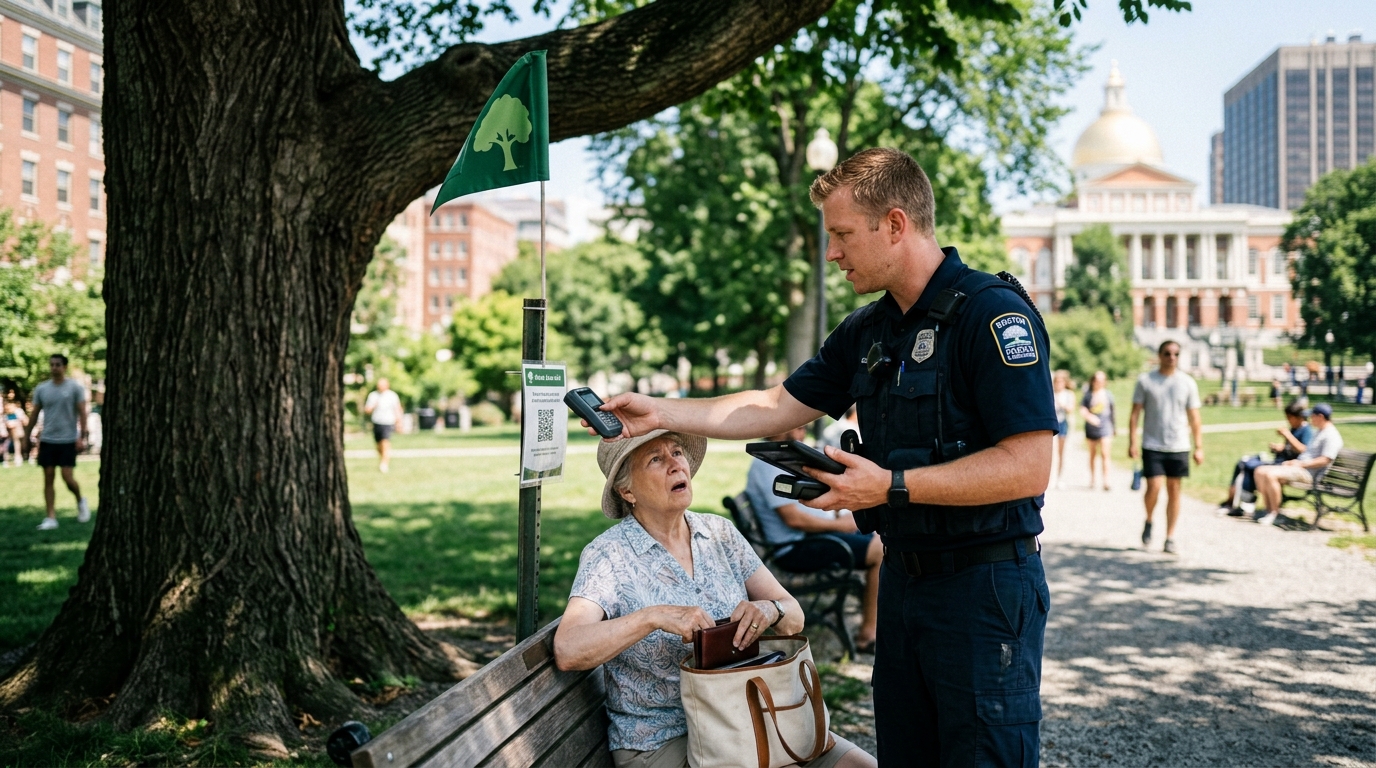
BOSTON — The Boston Parks and Recreation Department, in partnership with urban-technology firm UmbraSystems, has completed the rollout of "dynamic canopy management" across the Boston Common, introducing a tiered subscription model for park-goers wishing to utilize the shade of the park’s historic elm and oak trees.
The program, which began as a pilot last summer, utilizes "AeroShade" technology to regulate access to cooling zones. Each of the park’s mature trees has been retrofitted with trunk-mounted lidar sensors and motorized, reflective branch-baffles. When a visitor sits on a bench beneath a managed tree, the system scans for an active mobile pass. If no subscription is detected, the carbon-fiber baffles in the upper branches automatically tilt, redirecting the tree’s natural canopy shadow away from the bench and exposing the occupant to direct sunlight.
Under the new pricing structure, park visitors can choose between three access tiers. The "Solar Standard" tier is free of charge and offers 100 percent direct exposure to the elements. For $14.99 per month, the "Dapple Pass" grants access to 40 percent natural shade coverage, achieved by pulsing the motorized baffles at three-minute intervals. The premium "Deep Canopy" tier, priced at $29.99 per month, provides continuous, 95 percent solar blockage, alongside priority reservation rights for the most structurally symmetrical trees.
Janet Vance, deputy commissioner of municipal assets for the city, defended the initiative as a necessary measure to fund urban forestry preservation without raising property taxes.
"The trees themselves remain entirely public property, and anyone is free to look at them," Vance said. "However, the specific micro-climatological relief generated by their leaves is a finite municipal resource. For too long, passive cooling theft has allowed non-paying users to benefit from the expensive root maintenance and pruning paid for by our taxpayers. This partnership allows us to monetize the thermal output of our canopy in a highly targeted, equitable way."
To enforce the new boundaries, UmbraSystems has established strict "anti-piracy" protocols within the shade zones. Because the lidar sensors map the exact physical footprint of the shadow, the system can detect when an unsubscribed individual attempts to sit close to a paying subscriber to catch the edge of their shade.
According to the UmbraSystems terms of service, this behavior, known as "shadow-pooling," triggers an immediate canopy recalibration. The motorized baffles will narrow the shadow to a precise, 18-inch diameter directly over the paying customer’s head, leaving any unauthorized companions illuminated by a sharp beam of direct sunlight.
Greg Thorne, vice president of spatial monetization at UmbraSystems, explained that the technology is designed to respect the physical limits of natural resources.
"We aren't creating the shade; we are simply optimizing its distribution," Thorne said during a press demonstration near the Soldiers and Sailors Monument. "In a warming world, cooling is a premium product. If you go to a theater, you don't expect to sit in the front row for free just because the stage is already there. The canopy is the stage, and the shade is the performance. We are just ticketing the seats."
For local residents, the transition has altered the daily routine of public recreation. Elena Rostova, a paralegal who has eaten her lunch on the Common for six years, described the difficulty of navigating the new spatial dynamics.
"I used to sit under the Great Elm, but now the moment I sit down, I hear this little whirring sound in the branches, and a spotlight of 92-degree sun hits me right in the face," Rostova said. "I tried sitting behind a municipal recycling bin to use its shadow instead, but the city recently retrofitted those with angled, reflective sheet metal to prevent unlicensed heat-shielding."
Rostova added that she eventually purchased a "Dapple Pass," but found the alternating three-minute bursts of heat and shade left her feeling disoriented.
Despite local pushback, municipal leaders across the country are reportedly watching the Boston experiment closely. City councils in Chicago and Austin have already requested consultations with UmbraSystems to discuss similar retrofits for lakeside breezes and public lake access.
Meanwhile, some arborists have raised concerns about the health of the historic trees, noting that the constant mechanical adjustments of the heavy carbon-fiber baffles have caused several 150-year-old elms to drop their leaves prematurely. UmbraSystems dismissed these concerns, attributing the defoliation to "canopy optimization stress" and noting that subscribers can opt-in to a $2.00 monthly "Stewardship Surcharge" to fund the installation of lifelike, UV-resistant synthetic replacement leaves.