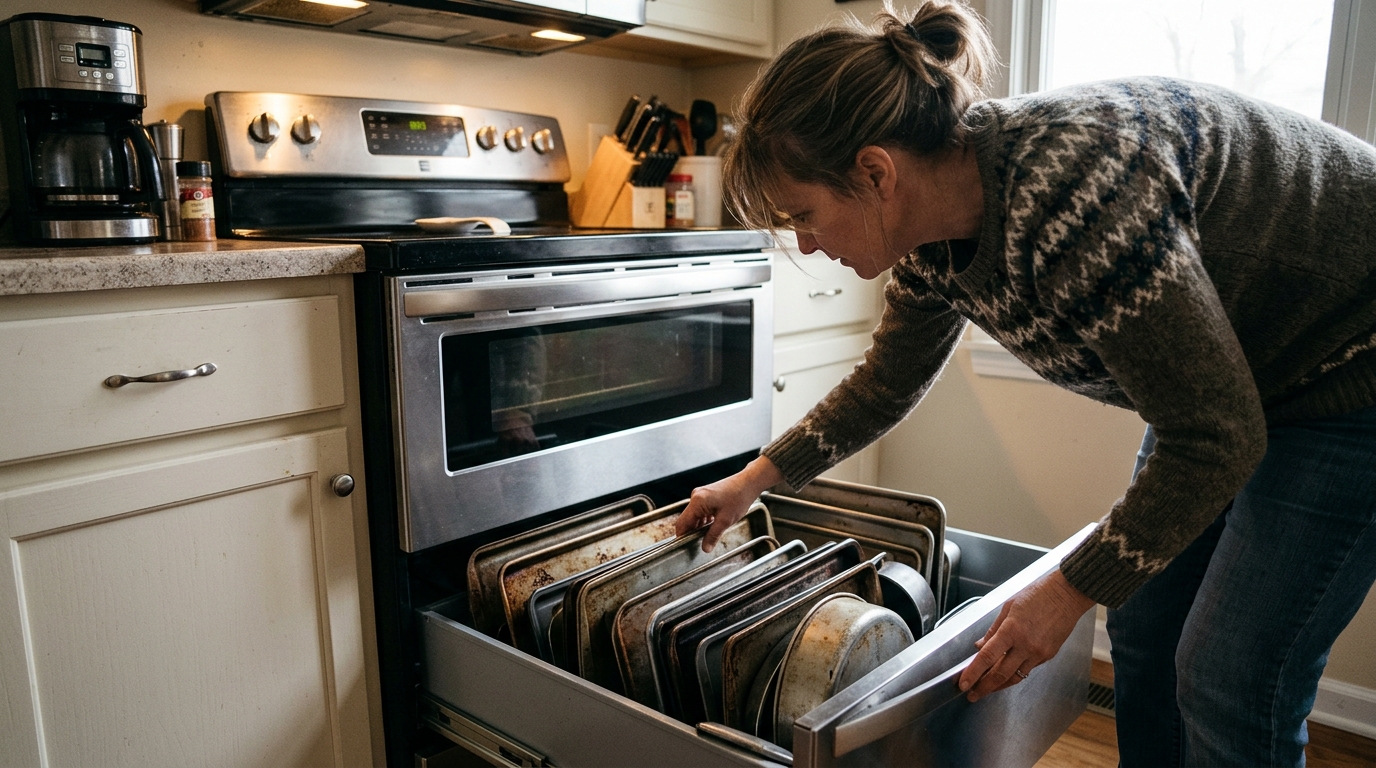
BENTON HARBOR, Mich. — Following an intensive, 18-month consumer behavior study costing upwards of $8.2 million, appliance manufacturer Kensington Home Systems announced Tuesday that the drawer located at the very bottom of the standard kitchen range is used almost exclusively to store mismatched metal baking sheets.
The findings, published in a 114-page corporate white paper titled Project Underbelly, have reportedly sent shockwaves through the company’s product development division, which had spent the last two decades engineering the space as an active "convection proofing and plate-warming chamber."
According to the study, which tracked 1,200 households across North America using motion-activated cameras and thermal sensors, 99.7% of participants did not know the drawer could generate heat. Instead, researchers observed a universal human instinct to pack the narrow cavity with nested muffin tins, warped pizza stones, and a single rusted cast-iron skillet that is too heavy to put anywhere else.
"We observed a consistent, cross-demographic phenomenon where consumers bypass the engineered thermal capabilities of the lower unit entirely," said Dr. Aris Thorne, Vice President of Global Consumer Insights at Kensington. "We discovered that when a consumer opens this drawer, they do not do so to pre-heat a dinner plate. They do so to retrieve a cookie sheet, producing a metallic clattering sound that can be heard up to three houses away."
The study further revealed that 84% of consumers experienced "mild to moderate irritation" when forced to bend down to the floor to retrieve a pan, yet 100% of those surveyed refused to store the pans in any of their designated vertical cabinets.
Participants in the study expressed surprise that Kensington had only recently uncovered the behavior.
"They paid me a $150 stipend to sit in a room and explain why I keep four circular pizza pans from 2012 under my oven," said Sarah Jenkins, a focus group participant from Grand Rapids. "They wrote down 'accidental legacy storage' on a whiteboard like they had just discovered a new element on the periodic table. I told them everyone I know does this. My mother did this. My grandmother did this. The researcher looked like he was going to throw up."
In response to the data, Kensington’s marketing team announced plans to phase out the "warming drawer" terminology in their 2027 appliance lineup. Future models will instead be marketed as featuring an "Engineered Acoustic Nesting Chamber," allowing the company to raise the retail price of its baseline convection ovens by $150.
"This represents a paradigm shift in how we conceptualize dead-space utilization in the modern kitchen," Thorne said. "By accepting that our customers prefer a dark, loud drawer for their neglected cookware rather than a state-of-the-art dough-rising station, we can better serve their desire to never bend over to look at what is actually in there."
Kensington’s board of directors has already approved a follow-up $11 million study for fiscal year 2027, which will investigate why every household has a single, deep cabinet filled entirely with plastic food storage containers that do not match any available lids.