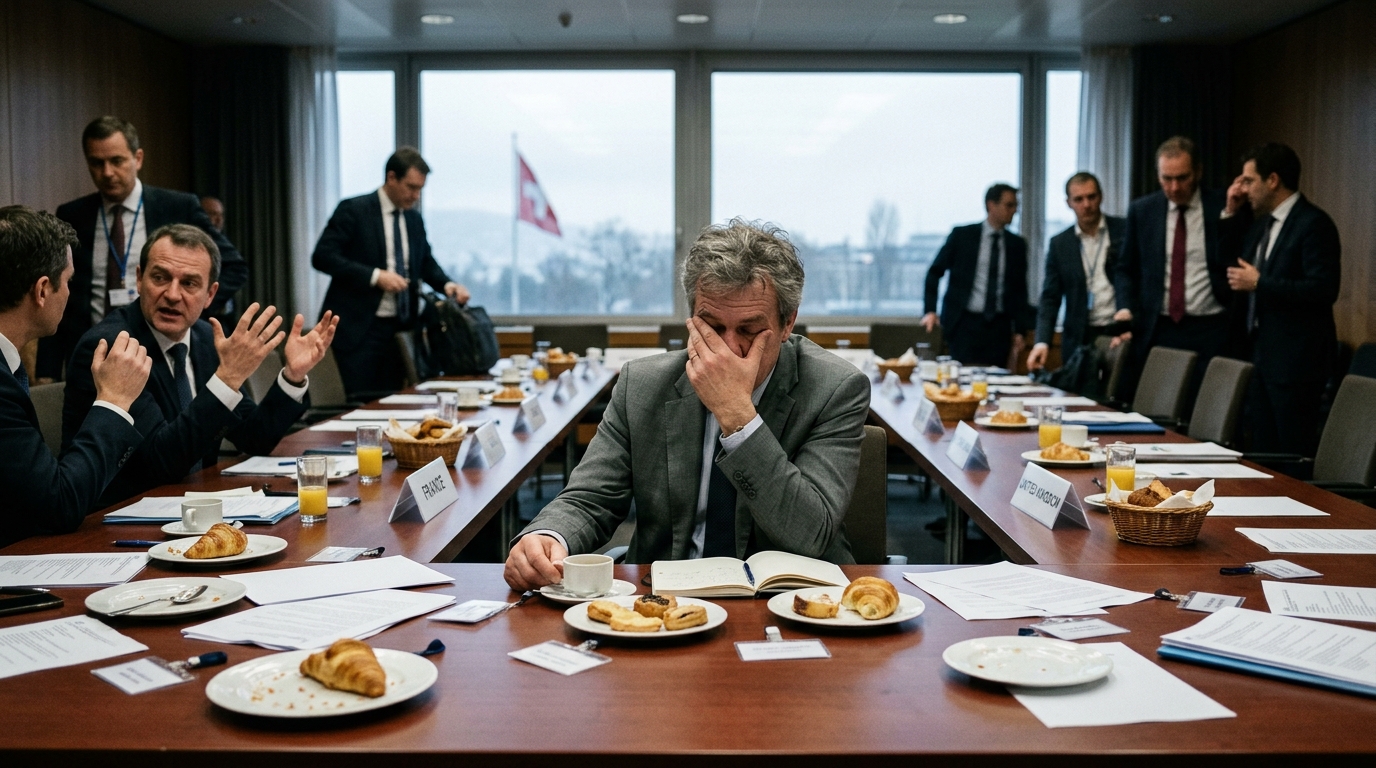
GENEVA — Negotiations for the multilateral Global Economic Alignment Treaty (GEAT) collapsed in Geneva on Friday after delegates failed to reach a consensus on the geographic classification of the summit’s morning catering menu.
The sudden breakdown of the talks, which aimed to standardize supply chain tariffs across 42 nations, occurred during a closed-door session on draft agenda structures. According to sources inside the Palais des Nations, the dispute began when the Swiss hosting committee designated the 8:00 a.m. meal option as a "Continental Breakfast," drawing immediate, formal objections from several non-mainland delegations.
"We cannot in good conscience sign off on a framework that implicitly defines 'the continent' through a mid-twentieth-century culinary lens," said Marcus Vance, a senior negotiator representing the British delegation. "To suggest that a pastry selection consisting exclusively of croissants, pain au chocolat, and seasonal preserves represents a universally neutral starting point for global trade discussions is, frankly, a protectionist stance by omission."
The dispute quickly escalated into a procedural gridlock. Delegates from maritime nations argued that the inclusion of Swiss-style muesli without a corresponding hot oat option discriminated against northern hemisphere climates. Meanwhile, a coalition of South American representatives demanded that the term "seasonal fruit" be codified in an official annex to prevent the introduction of unapproved stone fruits from non-treaty nations.
By Thursday afternoon, Swiss organizers attempted to salvage the $12 million summit by proposing the "Geneva Accord on Morning Nutrition," a compromise document that would have rebranded the buffet as an "Intercontinental Starch and Beverage Station."
However, the French delegation exercised its veto on the draft, objecting to a clause that classified the danish as an "equivalent laminated dough product" to the brioche.
"There are red lines in diplomacy, and the equivalence of yeast-leavened sweet breads is one of them," said Elena Rostova, a deputy trade minister who observed the proceedings. "When you allow a Danish pastry to be categorized alongside a classic French viennoiserie under a single, unregulated umbrella term, you invite the deregulation of the entire agricultural sector. We cannot negotiate maritime fishing rights when the very bread on our plate represents an un-demarcated border."
The collapse of the talks leaves billions of dollars in proposed tariff reductions in limbo. Economists warn that the failure to ratify the treaty could lead to immediate price increases on consumer electronics and automotive parts.
In a closing press conference, the Swiss Ministry of Foreign Affairs expressed regret over the impasse but defended the catering staff’s neutrality.
"Our kitchen followed the highest standards of diplomatic gastronomy," said ministry spokesperson Alistair Sterling. "Every effort was made to balance the sodium levels of the salted butter to reflect both Atlantic and Pacific preferences."
The delegations have returned to their respective capitals. No date has been set for a resumption of the trade talks, though a sub-committee has been established to research the geopolitical implications of the afternoon tea service ahead of the 2027 summit in Tokyo.