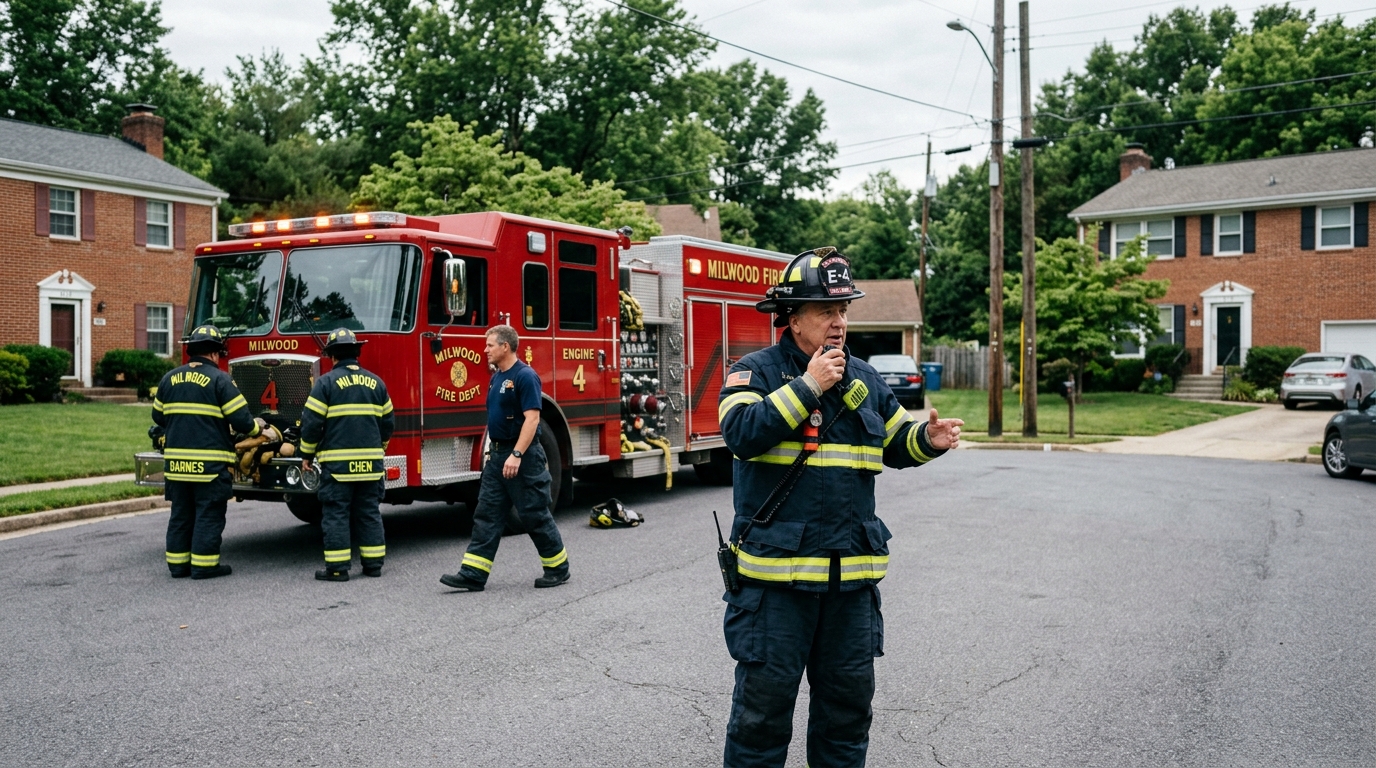
MILWOOD, Ore. — The Milwood Fire Department dispatched two engines and an emergency rescue vehicle to the intersection of Maple Street and 12th Avenue on Monday morning, acting not on reports of smoke or injury, but to correct an increasingly volatile lack of incident data in the municipal registry.
The deployment, authorized by the Office of Municipal Data and Resource Optimization, was triggered after the city’s predictive safety software, CivicPulse, flagged Sector 4 for maintaining a zero-incident record for 14 consecutive days—a statistical anomaly that threatened to disrupt the city’s federal public safety grant eligibility.
"When a sector remains completely quiet for two weeks, it creates a dangerous downward skew in our operational readiness metrics," said Milwood Fire Chief Donald Vance. "If we allow our active-response data to flatline, the county’s automated underwriting algorithm assumes our equipment is offline or decommissioned. We had to establish an active presence to reassure the system that Sector 4 still exists within normal parameters of municipal risk."
Upon arriving at the quiet suburban intersection at 9:14 a.m., firefighters deployed three traffic cones, unspooled 50 feet of dry hose onto the asphalt, and stood near a storm drain for 42 minutes to satisfy the GPS telemetry requirements of the dispatch software.
According to city records, the intervention successfully restored the neighborhood's risk profile to "moderately stable," preventing an automatic software-generated downgrade of the city’s emergency readiness rating.
Dr. Aris Thorne, Principal Analyst at Municipal Risk Solutions, defended the dispatch as a necessary measure in the era of algorithmic governance.
"An empty dataset is, functionally speaking, a corrupted dataset," Thorne said. "If the model expects a baseline level of friction and finds absolute tranquility, it begins to hallucinate systemic failures. By introducing a controlled, highly documented non-emergency to Maple Street, we neutralized the variance before the system felt the need to simulate a larger catastrophe to balance its ledger."
Residents of the neighborhood watched from their porches as firefighters methodically checked the pressure of a fully functional fire hydrant and recorded the surface temperature of a nearby oak tree.
"They didn't seem to be looking for a fire," said Martha Gable, who has lived on the corner of 12th Avenue for twenty years. "One officer asked me if I had any damp cardboard that might produce a light, compliant haze, but I told him I’d already recycled it. He thanked me, logged something on his tablet, and told me my cooperation had been statistically vital."
The fire department confirmed that no water was discharged during the operation, and no personnel were injured, though one firefighter was treated on-scene for mild administrative fatigue.
With Sector 4's data integrity restored, city officials are already looking ahead to potential anomalies in other departments. According to internal memos, the Department of Public Works is currently monitoring a three-mile stretch of newly paved asphalt on Elm Boulevard that has gone six weeks without developing a single pothole—a structural perfection that planners warn could trigger an automatic 12 percent reduction in next quarter's state transit funding.